Wednesday, October 9, 2019

Scapegoat Country by Sarah Jones for Dissent Magazine


Scapegoat Country | Dissent Magazine
Sarah Jones
 
Fall 2019 issue
 
Dissent Magazine
 

Scapegoat Country

Since the 2016 election, the American press has fixated on rural communities and created a dubious new genre: the Trump Country Safari.
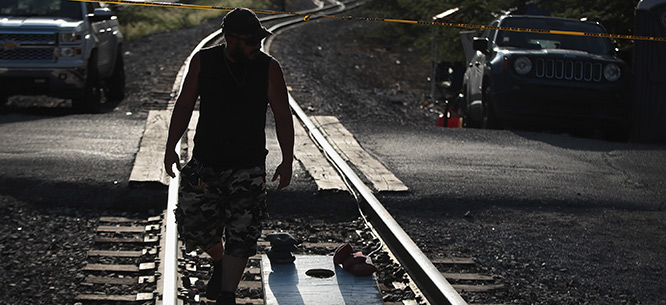
A former Blackjewel coal miner demanding backpay blockades the train tracks leading to their old mine in Harlan County, Kentucky. (Scott Olson/Getty Images)
In the rural town of Fergus Falls, Minnesota, there is one movie theater, and it played American Sniper for two years. Locals hated Mexican immigrants and prayed for Trump on Sundays; their town manager was a virgin who thought Hillary Clinton wanted to steal his guns. With anecdotes like these, the German journalist Claas Relotius painted the scene of a regressive and even frightening place in a 2017 article for Der Spiegel. At a “Western evening,” the townsfolk dressed up in cowboy gear and danced to country music. After all, what else is there to do in a small, scary town deep inside a lonely forest?
Plenty, the residents of Fergus Falls responded. In a self-published Medium piece, locals Michele Anderson and Jake Krohn revealed that Relotius’s portrait of rural America bore little resemblance to reality. American Sniper had played for two months, when it first premiered in 2015. There was no “Western evening.” Fergus Falls is located on a prairie, not in a forest. A man identified as a coal-shoveling Trump voter had never worked in a coal mine or even the town’s coal-fired plant. And while Trump did capture most of the town’s votes in 2016, Relotius exaggerated the president’s margin of victory by eight points.
Der Spiegel retracted its Fergus Falls story and pressed charges against Relotius for fabricating it and other articles. His motivations aren’t difficult to understand. By the time he traveled to Minnesota, Relotius had won multiple awards; editors of Der Spiegel have said that he felt pressured to repeat his early successes. But hubris can’t completely explain the lies Relotius told. Fergus Falls, he claimed, inhabited a malevolent-sounding forest “that looked as if dragons lived in it,” as another Der Spiegel reporter put it. The implication is clear. Fergus Falls is off the map. Here be dragons. He was the brave explorer who had confronted them inside their lair.
Americans had just elected Trump, and shocked commentators were quick to lay the blame for this previously inconceivable outcome on rural voters and their provincial hatreds. Relotius assumed, perhaps, that nobody in Fergus Falls would ever read Der Spiegel, or find a German translator—let alone come up with a rebuttal.
Relotius is an extreme case. But even his fabrications were derivative. He did not create the tropes he used. He merely exaggerated them and projected them before new audiences.
In 2016, as Donald Trump transitioned from joke candidate to Republican frontrunner, the American press fixated, often, on rural communities like Fergus Falls. Most journalists didn’t seem interested in learning anything about the places they wrote about. Instead they churned out vacuous just-so stories. Trump supporters believed he would create jobs and save babies from bloodthirsty liberals, so they voted for him and then celebrated his victory. Imagine! Each week readers could open their newspapers and find an entry in the catalog of a dubious new genre: Trump Country Safari.
The subject of a Trump Country piece is usually white, disgruntled, and committed, still, to the jingoism the president embodies. The journalist rarely identifies the characteristics of that jingoism or shows much curiosity about the source of its appeal. This approach yokes rural America firmly to Trump in the public mind while sidestepping white nationalism. The stories are, as Ashley Feinberg of the Huffington Post wrote, a form of “pornography,” produced “less as a way of explaining the country to their audience than as a way for media outlets to gratify themselves, or perhaps to atone for the perceived sin of overlooking Trump supporters the year before.”
Trump is not the president of just rural America. He won office because his message took root in coastal cities and suburbs, too. But national reporters found few occasions to explore the ascendant conservatism of these places. Consider Collier County, Florida, and McDowell County, West Virginia, two counties that voted heavily for Trump. Despite the fact that Collier County’s voter turnout was more than twice that of McDowell County, only the latter drew national attention. The wealthier, more suburban residents of Collier County did not inspire the derision of liberals—nor did they command the attention of conservatives, who were eager to pin Trump’s success to the reactionary yearnings of the mythologized heartland worker.
This selective interest in a particular type of Trump voter—and the synonymization of white conservatives with rural geographies—reinforced perceptions many onlookers already possessed. Location alters a place’s material needs and shapes the struggles of its inhabitants, but rurality does not make a community simple. To many consumers of the mainstream press, however, rural communities seem to be benighted places where the light of liberalism could not reach.
I had only been working as a full-time journalist for two and a half months by the time Trump became president, but I had been angry at the national press, and its coverage of rural America, for a long time. I am from southwest Virginia. Three generations of my family live there and in neighboring east Tennessee. The Appalachia I read about in the New York Times, the New Yorker, and the Associated Press was an Appalachia I recognized, but only through a fractured mirror of distorted facets. I felt like I was watching the parable of the blind man and the elephant unfold in real time. My new peers had missed the elephant for his limbs. They had been distracted by the roughness of his skin and the strangeness of his trunk. The Trump moment provided the occasion for them all to try their hand at depicting this elephant, which had long been in the room but rarely noticed by the national press.
So I wrote about the elephant. I didn’t know what else to do. And I wasn’t alone. Fergus Falls debunked its own grimdark reputation. Journalist Sarah Smarsh rebuts similar stereotypes about the Midwest in her articles and in her recent memoir, Heartland. But writers who try to inject more nuance into national coverage of rural America can find themselves at odds with other members of their own industry. Markos Moulitsas, the liberal strategist and co-founder of Vox Media, reacted with glee to news that retired coal miners faced losing their pensions. “Don’t weep for these coal miners, now abandoned by their GOP patrons,” Moulitsas wrote. “They are getting exactly the government that they voted for. Democrats can no longer offer unrequited love and cover for them. And isn’t this what democracy is all about? They won the election! This is what they wanted!”
That kind of reaction puts rural Americans—and journalists—in a difficult position. We state the obvious. We point to the elephant. I say that, actually, voter turnout is very low in many counties in Appalachia. Perhaps it would be a better use of our time to ask ourselves why—for example, the decline of union membership, or a generalized feeling of disenfranchisement reinforced by poverty—rather than focusing all our attention on the people who did turn out to vote for Trump.
Many other correctives seem almost self-evident from the perspective of someone who’s actually lived in rural America, and yet for readers who have been fed a diet of fabulism, they take on the appearance of stunning exposé. Rural America is not necessarily white. Rural America is indigenous. It’s home to Affrilachian poets; to queer people and to immigrants, like the poultry plant workers ICE rounded up in Grainger County, Tennessee, in 2018. The Black Belt of Alabama is rural and poor and mostly non-white, and so is the Delta. All these people, all these places, are rural America. Coverage that focuses exclusively or at least principally on white, rural conservatives minimizes the real extent of the nation’s racism, as if racism subsides as population density increases. It erases people of color from regions they’ve inhabited—in direct defiance of violent white supremacy—for centuries. Simplistic journalism makes rural America a sin-eater: a tainted place that in the public imagination absorbs a nation’s fear of the other. Rural America thus becomes a scapegoat to soothe liberal consciences. Once whitewashed, the right wing can adopt it as the beating heart of the herrenvolk.
Rural communities don’t conform neatly to right-wing or even liberal imaginings, but those realities often don’t appear in outsider coverage. National outlets often not only overlook rural people; they may also miss rural organizing that occurs outside electoral politics. In 2017, I traveled to rural Coos County, New Hampshire, where local dairy farmers had joined forces with the Pessamit Nation of Quebec and Yale University students to protest a planned hydroelectric project in the area. The Pessamit feared that the project would damage their ancestral fishing grounds; New Hampshire farmers feared not only the loss of their country views but the environmental damage that could occur as a result of construction; the Yale students wanted to protest what they characterized as the university’s complicity in the project (Yale owned large forested tracts through which the Northern Pass project would run). It was an unusual alliance of interests—indigenous people, conservative farmers, and liberal students—coalescing around a Trump-voting county in the northern woods of New Hampshire. But it’s a story that national outlets largely missed—a casualty, perhaps, of a professional obsession with simpler political binaries.
Coos County isn’t such an outlier. Similar activist alliances have cropped up elsewhere in rural America. Though they aren’t proof that conservative communities are reliably shifting left, they complicate what many people think they know about rural places. Teachers’ strikes in West Virginia and in Oklahoma, where some rural school districts only have resources available for four days of class a week, again reshaped national perceptions of rural, Republican-dominated places. In southwest Virginia and West Virginia, locals continue to organize against the Mountain Valley Pipeline, which would carry fracked gas through the region and would cross the Appalachian Trail in at least one location. Some activists have taken to tree stands and monopods, living on top of what amounts to a very large stick in order to block construction on the pipeline. And in Harlan, Kentucky, after Blackjewel, a major coal operator, abruptly declared bankruptcy and left over a thousand miners without backpay, trans anarchists helped laid-off workers occupy a stretch of railroad. For weeks, they were united in service of the same goal: to block coal trains from getting out and to train national eyes on the injustice their community had endured.
The people who make up these coalitions certainly do not agree on the precise policy solutions to local troubles. Nor is there consensus on the sources of those problems. Pipeline fights and coalfield occupations don’t tell us that a Green New Deal, for example, will be an easy sell. But these tensions are a story on their own, and one that outsider perspectives tend to ignore in favor of blunter tales.
What sort of clarity do the Mountain Valley stylites provide? The epiphany they offer is a simple one. Rural Americans, for instance, want clean water like everyone else. They want communities fit not only for their children, but for grandchildren and great-grandchildren. It isn’t paradoxical for some rural communities to long also for the return of coal mining; communities aren’t hive minds. People want jobs, even if that means the resurgence of an environmentally and medically dangerous industry like coal mining, because the alternative is poverty. These observations, again, are nothing more than statements of the obvious if the starting point for reportage on rural America is a search for complexity and humanity rather than exoticism.
As a writer from Appalachia living in New York, I wonder, sometimes, what good I’ve accomplished from my own position in the national press. But as revenues decline and hedge funds bleed local and regional newspapers dry, it’s increasingly difficult to pursue journalism closer to home; these material forces have helped widen the distance between national outlets and rural communities. The proliferation of stories about “red America” suggests that to some in the industry, distance might not be a problem, but rather proof of their own superiority.
I don’t believe, really, that there is a “red America.” There’s a falsehood buried in the term. Rural voters may behave differently than voters in the suburbs or the cities, but they hardly occupy a separate country, and there is no such thing as a monolithically conservative region. “These are people who have lived in places where 7 out of 10 local races are uncontested by the Democratic Party, who have maybe felt unhappy with our choice of national candidates for myriad reasons,” said Smarsh in a 2018 interview with Longreads. “It’s about acknowledging that these places that we call ‘red’ contain millions and millions and millions of people who have never even voted before.” For similar reasons, I think “Trump country” is about as real as Neverland. It mostly exists for journalists who only go to isolated towns when it’s time for a national election. But I’ve used both terms to sell stories to editors and readers. Why perpetuate what I believe to be myth?
I often don’t have a choice. Reporters typically bear little responsibility for the priorities and prejudices of their editors, and editorial demand keeps the Trump Country Safari alive. It has sometimes only been possible to convince anyone—editors and readers with an anthropologist’s voyeuristic curiosity—that rural stories deserve coverage by hooking them to Trump, a topic that’s guaranteed to generate clicks driven by adoration or outrage. But this hook encourages shoddy work. An individual county’s overall vote for president tells us nothing—in isolation—about its political and economic history or its internal divisions. In the absence of context, fables are easy to generate and hard to kill.
At one extreme sits Claas Relotious, who published lies he thought people would believe. It’s possible, though, to tilt too far in the other direction, to focus exclusively on teachers’ strikes and environmental activism and paint rural America in soft and gentle colors. When rural whites do vote, they still tend to support conservative candidates, and economic inequality alone can’t explain this pattern. The trick is to interview their neighbors, too—the people of color and non-Christians who carve out lives among people whose political preferences actively endanger them. It’s difficult for some people to go home, when going home means being openly queer in a town full of conservative Christians, or sacrificing steady work for a more precarious economic future.
Rural Americans aren’t exceptional. Their needs and hopes may be influenced by the presence of resources like coal and natural gas, or by the physical difficulties imposed by dense forest, mountain terrain, and open prairie land. But physical distance from the centers of the media industry hardly severs communities from the polity of the nation. Whatever afflicts rural America afflicts the suburbs and the cities, too. Capitalism does not respect city lines. The distinguishing characteristics of rural problems simply reveal new flaws in the same broken system. When people die of overdoses in rural places, it’s not due to some cultural curse specific to the prairie or the hollow, but because they lack access to healthcare, and because corporations and pharmaceutical wholesalers have flooded their communities with pills. Rural people suffer from structural problems ranging from environmental decimation to rapidly greying demographics. While there are places where the consequences of these problems are more and less pronounced, there’s no way for anyone to completely escape them. If that reality isn’t visible in an article, then the author’s failed herself, her readers, and her subjects.
And that may well be an error that national reporters, so often located in one of about three major coastal cities, are more prone to make. I don’t believe this means that city-dwellers ought to exempt themselves from covering rural places and people. I am a labor reporter, and it’s my responsibility to cover teachers’ strikes in West Virginia even though I no longer live in easy driving distance to the state. But there are ways for the industry to support better and more incisive reporting on rural communities. Redirecting resources to local journalists, as initiatives like Report for America and ProPublica’s Local Reporting Network already do, would do much to rectify the gross flaws in the nation’s coverage of rural people.
The key to preventing more Relotiuses is to ensure that rural communities are empowered to tell their own stories. Told by those who know best, rural stories might not satisfy the stereotypes or partisan divisions that outsiders hope to see in them. Trump’s ruthless and reactionary rhetoric won’t be so easy to pin on rural America—nor will the people who live there make such easy scapegoats for everyone else.

Sarah Jones is a staff writer for New York Magazine, where she covers national politics and social inequality.

National Review’s Strained Defense of Trump The New Republic / by Matt Ford

National Review’s Strained Defense of Trump


The New Republic / by Matt Ford / 1h

Last Monday, I wrote that President Donald Trump’s supporters haven’t mounted a plausible enough defense of his involvement in the Ukraine scandal to avoid impeachment. His surrogates tripped and stumbled throughout their appearances on the previous weekend’s Sunday talk shows, and their performances haven’t improved much since then. The public seems to agree: A Washington Post poll released on Tuesday found that 58 percent of Americans now support the House’s impeachment inquiry, and 49 percent of Americans think Trump should be removed from office for it.


Trump’s own attempts to defend himself have backfired. The president undercut his own supporters on Thursday by publicly urging the Chinese and Ukrainian governments to open investigations into former Vice President Joe Biden. The best explanation that loyalists like Lindsey Graham and Marco Rubio could offer at the time was that Trump was making some kind of joke—an incredulous claim at best. By the time the next Sunday arrived, nobody from the White House or from the GOP’s congressional leadership was willing to appear on the weekly talk shows to defend him.

That hasn’t stopped others from trying. Two National Review pieces on Monday made a furtive effort to carve out a more nuanced view of the Trump-Ukraine saga than what the White House has heretofore been capable of producing. Andrew McCarthy, a former federal prosecutor, argued that Trump’s behavior seems to have fit within the normal bounds of American diplomacy. The magazine’s editors tried to take the rhetorical high ground, arguing that all sides were flawed and impeachment wasn’t warranted. Both pieces strain themselves to minimize and normalize Trump’s abuses of power. Both fall short of making a convincing case.

McCarthy largely does not dispute the facts surrounding Trump’s conduct. But he also offers a misleading portrait of Biden’s actions alongside them. “I have always assumed, for argument’s sake (and, increasingly, because it appears to be true), that the president slow-walked defense aid to pressure Ukraine both to assist the Barr investigation and to probe Biden’s activities in Ukraine,” he wrote. “On the latter, I am referring to Biden’s extortion of Kyiv to fire a prosecutor who may have been investigating Burisma, an energy company that, under circumstances that smack of self-dealing, retained Biden’s son on its board.”

It’s worth dissecting those assumptions a bit further. It’s indisputable that Hunter Biden’s board seat on Burisma was unsavory at best. It’s also indisputable that Biden pressured Ukraine’s then-president Petro Poroshenko to dismiss Prosecutor General Viktor Shokin over his handling of corruption investigations. One of these investigations was a probe into Ukrainian oligarch Mykola Zlochevsky, the owner of Burisma. McCarthy’s juxtaposition of these facts might lead a reader to conclude that Biden used his position as vice president to undermine an investigation that could affect his son. That would be profoundly troubling if it were true.

But all of the available context points in the other direction. The Obama administration’s problem with Shokin wasn’t that he was going too hard on oligarchs like Zlochevsky; it was that he was going too easy on them, often by slow-walking and shelving anti-corruption cases. What’s more, Biden and the Obama administration weren’t alone in criticizing how Shokin handled those cases. The European Union and the International Monetary Fund also urged Kiev to oust him, as did Ukrainian anti-corruption activists and reformers. So did three Republican senators, who signed a letterin 2016 that urged Ukraine’s president to reform the prosecutor general’s office. Poroshenko and other top Ukrainian officials have disputed Trump’s narrative and said Biden never discussed specific cases with them.

McCarthy also tries to normalize Trump’s approach to Ukraine. “To listen to commentary, not only by anti-Trumpers, but even some Trump defenders who don’t seem to understand what they’re talking about, one would think that a quid pro quo is always bad, and that it is a terrible thing to pressure a foreign government,” he wrote. He argues that what Trump’s opponents describe as a “quid pro quo” is actually just bargaining in American foreign relations, and that the alleged “extortion” is just a form of diplomatic pressure that one government applies to another. Trump’s actions, clumsy as they may be, are reimagined as statecraft in McCarthy’s retelling.

There’s a kernel of truth here. Presidents often seek things from foreign powers and offer them things in exchange. The U.S. government also uses a variety of soft-power and hard-power tools to pressure other countries into taking actions they would prefer. This is Foreign Relations 101. What sets Trump’s Ukraine dealings apart is not the means by which they were undertaken, but the underlying rationale that guided them. In democratic countries like the United States, presidents aren’t supposed to advance their personal interests when conducting foreign relations, but rather a policy agenda that benefits the country as a whole.

McCarthy muddles that line between Trump’s personal interests and his policy agenda. “Presidents are in charge of foreign relations, and they pursue policies that they’ve run on,” he argues. “Presidents seeking reelection need policy successes. A president’s management of foreign policy and his political interests naturally overlap. At the same time, a policy that is good for the United States may have the collateral effect of politically damaging a president’s political rival. A president should not be discouraged from pursuing American interests just because doing so might help the president or harm the president’s opposition.”

It’s hard to accept the notion, however, that there is no real distinction between using American diplomatic power to secure a trade deal with Beijing that benefits Iowa’s soybean farmers, and personally urging Xi Jinping to sic the Chinese prosecutorial services after an American political rival and his family. Both of them make it easier for Trump to win re-election, so what’s the practical difference? McCarthy’s argument only superficially makes sense if it draws upon two faulty assumptions: that there’s a legitimate reason for foreign powers to investigate Biden for corruption, and that Trump’s interest in corruption overseas springs from anything resembling good faith.

This entire argument might hold more water if Trump showed any tangible interest in tackling corruption. His campaign pledges to “drain the swamp” haven’t resulted in any proposed legislation to rein in lobbying and influence-peddling in Washington. Federal white-collar prosecutions are nearing their lowest levels in more than three decades. By leaving three vacancies open on the Federal Elections Commission, Trump is making it harder to police campaign-finance violations ahead of the next election. And his personal refusal to fully divest himself from his business empire both violates the Constitution and opens him up to allegation after allegation of corrupt self-enrichment.

Trump’s disinterest in fighting corruption extends to foreign countries as well. He is a critic of the Foreign Corrupt Practices Act, one of the flagship federal anti-corruption laws. The FCPA forbids U.S. companies from bribing foreign governments; Trump has said those restrictions are flawed because they hurt American competitiveness. “Now, every other country goes into these places, and they do what they have to do,” he told CNBC in 2012. “It’s a horrible law and it should be changed. I mean, we’re like the policeman for the world. It’s ridiculous.” It’s more accurate to say that Trump’s interest in corruption only extends as far as he can accuse his opponents of it.

National Review’s editors appear torn by the realization that Trump did something wrong and the unease with letting him face any consequences for it. To their credit, they fault Hunter Biden for the appearance of “soft corruption” without alleging wrongdoing on the elder Biden’s behalf. The editors take issue with Trump’s handling of the scandal and his unhinged accusations of treason; they also critique Democrats for “itching to impeach Trump from the beginning.” Everybody is to blame for the current crisis, and so no one is truly responsible for it.

The editors’ ultimate conclusion is that all of this could be politically advantageous for Republicans next year. “The truth is that, absent some radical change in the dynamic, the House is inevitably going to impeach Trump and the Senate is inevitably going to acquit him,” they wrote. “What we’re essentially arguing about is how this impeachment and acquittal will be regarded in the run-up to 2020 by independents and persuadable voters.” From the trajectory of both the polls and the president’s coherence, that may be the most flawed assumption of all.

SHAREVISIT WEBSITE


No Wonder They Need Him Quiet Editors’ Blog – Talking Points Memo / by Josh Marshall

No Wonder They Need Him Quiet


Editors’ Blog – Talking Points Memo / by Josh Marshall / 29min


CNN is reporting that immediately after the President’s notorious July 25th phone call with Ukrainian President Zelensky. According to Shimon Peokupecz, “aides to Trump scrambled in the aftermath of his July 25 phone call with Ukraine’s leader both to alert lawyers of their concerns and to contain the damage. Unsettled aides also immediately began quizzing each other about whether they should alert senior officials.”

This is not terribly surprising. It’s basically in line with other reporting. But this tells us something important.

As we’ve already learned, this call and the President’s asks were not out of the blue. The President’s emissaries, official and unofficial, had been pushing this exchange for months. Other than the President saying these things himself, over official channels, there’s really nothing new about what he said.

So why were these unnamed officials so freaked out?

There are two possibilities here. One is simply that these other aides and officials knew this stuff was going on but did not expect or at least hoped Trump wouldn’t get into the explicit quid pro quo on the call. That’s certainly possible. But it doesn’t sound right to me. This is Trump after all. He’s known for intemperate remarks, being too direct, being indiscrete. It’s hard for me to imagine that if staffers knew this was happening, knew the President was a part of it and knew the call was related to it that they’d be running around like their hair was on fire. At a minimum they would have known this was a strong possibility if not necessarily a likelihood.

What seems much more likely is that a number of the aides or staffers on this call – which would include everyone from the highest level political appointees and more anonymous duty staffers in the Situation Room – did not know this stuff was happening. They were out of the loop, as the phrase goes. Or at least they didn’t know the President had so closely involved himself.

So what it sounds like we have happening here is the President’s private channels diplomacy suddenly collided with official channels diplomacy.

I raise this because it’s relevant to Gordon Sondland.

NBC reported a short time ago: “U.S. officials and others with knowledge of their relationship also say that Sondland is part of a small cadre of ambassadors who enjoy direct and frequent access to Trump. They say the two speak frequently by phone and have spoken extensively about Ukraine in the past.”

It seems clear that Sondland was the confidant/trusted operator through whom Trump was operating. We had further confirmation today that when the acting Ambassador in Ukraine said he thought the extortion scheme was “crazy”, Sondland got on the phone with Trump then went back to text and gave that response that there was no quid pro quo as the President has always made clear.

For now the point is this. A lot of people pretty versed on Ukraine apparently didn’t realize this was happening, at least not that it had risen to the level of full extortion and election interference. So Sondland seems pretty key as the trusted fixer type, someone Trump could talk frankly to, Trump could talk to and operate through.

SHAREVISIT WEBSITE


Tuesday, October 8, 2019

The 'cancel culture' con by Osita Nwanevu for The New Republic

This summary is not available. Please click here to view the post.

What’s Behind Trump’s Move in Syria Editors’ Blog – Talking Points Memo / by Josh Marshall

What’s Behind Trump’s Move in Syria


Editors’ Blog – Talking Points Memo / by Josh Marshall / 4h

Since last night I’ve been trying to get my head around President Trump’s abrupt announcement that he has green-lighted a Turkish invasion of northern Syria. Like so many Trump decisions there are multiple and overlapping potential motivations and consequences. It seems to play into the hands of regional adversaries – Russia, Iran and erstwhile treaty ally Turkey. It appears rooted at least in part in President Trump’s hostility not so much to foreign military involvements but in any commitments (military or not) that are not narrowly transactional or of benefit to him.


Last night the White House put out a statement announcing the decision which read like it had been personally dictated by the President – another clue that this was the product of impulse rather than policy.

Notably the statement’s second half suggested one potential reason was a breakdown in negotiations or frustration with European allies over the repatriation of ISIS fighters captured during the conquest of the ISIS ‘caliphate’ and held prisoner in northern Syria by Kurdish militias allied with the United States.

In other words, passive aggressive petulance.

We of course don’t know what was conveyed or promised in the President’s call with Turkish President Erdogan which occurred yesterday and appears to have been the trigger for this decision. Given recent events, almost nothing is outside the realm of possibility for what was discussed.

All of these motivations likely play into the mix. But I suspect there’s one overriding one – one that makes it happen last night as opposed to two months ago or two weeks from now. President Trump feels increasingly threatened. He is struggling to dictate the pace of events rather than react to them – something being the American President usually allows a great ability to do. So this is a warning that he can still break things at will. Especially abroad, he can still take dramatic action with immediate results that others must react to.

We can likely expect a lot more of this as the threat of impeachment and possible (though highly unlikely) removal from office grows.

SHAREVISIT WEBSITE


Monday, October 7, 2019

The Culmination of Republican Decay by Sean Wilentz


The Culmination of Republican Decay
by Sean Wilentz, nybooks.com
October 10, 2019
The Culmination of Republican Decay
October 10, 2019 Issue
by Tim Alberta
Harper, 678 pp., $29.99
Early in Tim Alberta’s American Carnage, Peter Wehner, the head of President George W. Bush’s Office of Strategic Initiatives under Senior Adviser Karl Rove, remarks bitterly that John McCain’s choice of Sarah Palin as his running mate in 2008 presaged the rise of Donald Trump. Wehner deplores how his party, founded on “glorifying excellence and achievement,” came to embrace “this anger and grievance and contempt.” He had a different view in 2008, though, when he described Palin as the future of the Republican Party, which she had “suddenly revitalized” with her “grace and style.” Palin, he said, was “a supremely gifted political talent” whose “conservatism seems organic rather than manufactured, ingrained rather than recently imbibed.”

The main responsibility for Palin’s selection lay with two pillars of the post-Reagan Republican establishment: Bill Kristol, the neoconservative editor of The Weekly Standard and former chief of staff to Vice President Dan Quayle, and Steve Schmidt, McCain’s chief political strategist and previously a deputy assistant to President George W. Bush and counselor to Vice President Dick Cheney. In plucking Palin from obscurity, Kristol and Schmidt, like innumerable GOP leaders before them, were promoting the party’s indispensable hard-right base—a base it has done so much to arouse and exploit since the late 1960s. “A spectre is haunting the liberal elites of New York and Washington—the spectre of a young, attractive, unapologetic conservatism, rising out of the American countryside,” Kristol wrote breathlessly in early September 2008. “That spectre has a name—Sarah Palin…a challenger of a corrupt good-old-boy establishment who’s a conservative; a successful woman whose life is unapologetically grounded in religious belief; a lady who’s a leader.”

Kristol, Schmidt, and others somehow persuaded McCain that he could appease the reactionary elements in the GOP, including the white Christian right and the Second Amendment zealots, while still keeping the party firmly under control. In fact, Palin’s nomination was only one incident in the party’s continuing radicalization. After Barack Obama was elected president, the Koch brothers and the Donors Trust of dark money funders (to which the Kochs were leading contributors) would mobilize and subsidize the Republican base in the so-called populist revolt they named the Tea Party.

Wehner, Kristol, and Schmidt are today among the most prominent of what remains of the Never Trumpers, hoping against hope that they can wrest the Republican Party from Trump’s grasp. Wehner has fared the best, securing prestigious contributing writers’ posts at The New York Times and The Atlantic, and a fellowship at the right-wing Ethics and Public Policy Center. Kristol—whose magazine, once owned by Rupert Murdoch as a premier vehicle for conservatism, was closed under pressure from Trump—rails against the president on the cable-news talk shows. Schmidt, who formally broke with the party in 2018, was last spotted guiding into oblivion the quixotic third-party presidential aspirations of the former CEO of Starbucks, Howard Schultz. While they stumble around dazed, the Never Trumpers seem unable to admit, at least publicly, to their complicity in their own downfall. Nor do they seem to grasp that when Trump seized control of the GOP in 2016, he reaped the populist whirlwind that Richard Nixon began sowing nearly half a century earlier and that the Bush administration—their administration—had whipped to hurricane force.

American Carnage does not have much to say about the Never Trumpers’ continuing efforts, a sign of their irrelevance to the current Republican Party but also of their unassailable status to the book’s author. Alberta, a conservative-leaning reporter, reserves his admiration for those loyal Republicans who have resisted becoming Trump’s sycophants and who seem, to Alberta at least, poised to succeed him. Above all, he looks to Senator Mitt Romney, a figure contemptuously dismissed by much of the party for his defeat by Obama but who, now that Trump is in the Oval Office, has assumed “his true political identity” as a “sincere, pragmatic, well-intentioned statesman who sees that something is wrong and wants to help fix it.”1

Whether Romney or any other Republican can halt what Alberta calls the party’s “civil war” between its establishment and its hard-right wing, and then restore the GOP to what he considers normality, seems a very long shot given the intense devotion that the vast majority of Republicans have shown the president since his election. The struggle that American Carnage covers in fact may well be over, won by Trump and his loyalists—who are now drawn from both the establishment and the hard right—and leaving supposed moderates like Romney on the fringe.

Alberta’s guarded optimism about the party’s future, projected upon the once-and-future Romney, reflects a major limitation in his densely reported book: its paucity of historical background. He begins with Obama’s presidency, during which he started his reporting career, and there is some justification for his choice. Obama’s election was a pivotal moment in American history for many reasons, including how it further inflamed the right wing of the Republican Party. Given Trump’s obsession with his predecessor and his determination to destroy anything Obama achieved if only because he achieved it, the Obama presidency is a crucial point of reference for understanding Trump. Still, starting an account of the GOP’s civil war in 2008 is a bit like starting a history of the American Civil War after Gettysburg.

By the time Alberta’s account gets underway, most of the political dynamics behind the events he describes were long established and extremely powerful. Some of the book’s major figures, like former House Speaker John Boehner (who was also one of its principal sources), were remnants from earlier phases of the party’s strife, and developments like the growth of the Tea Party or the uprisings of the House Freedom Caucus make sense only as outgrowths of previous internecine battles. Most importantly, by 2008, the Republican Party had already become what the political scientists Thomas E. Mann and Norman J. Ornstein would call “an insurgent outlier” in American politics: “ideologically extreme… scornful of compromise; unpersuaded by conventional understanding of facts, evidence and science; and dismissive of the legitimacy of its political opposition.” Alberta has written, in short, a book that is more denouement than drama, detailing the fall of a hollow GOP establishment that, having abandoned normal party politics in favor of relentless polarization, was already teetering. While American Carnage describes the outcome of the party’s radicalization, it completely misses—indeed, fundamentally misunderstands—a major impetus behind Trump’s ascendancy: the destructive presidency of George W. Bush.

Alberta, a former reporter for National Review and The Wall Street Journal, and currently the chief political correspondent for Politico, is certainly an expert on the workings of high-level Republican politics, especially on Capitol Hill, and he is a demon researcher. He has also mastered the knack of culling juicy quotations and narrating colorful vignettes that seem to jump off the page, part scoop and part gossip. They confirm that Alberta has amassed a fortune in the debased coin of the realm of modern journalism, which is access; but they also display his genuine gift for fly-on-the-wall storytelling from certain Republican walls.

Many of these stories and quotations capture Trump in all his malignant megalomania, as practically all stories about Trump do, although Alberta’s take on them is sometimes questionable. One story describes how Trump caught on early to the charismatic appeal of Alexandria Ocasio-Cortez—“I called her Eva Perón,” the would-be American Juan Perón remarks—and how he boasted about his prowess as a talent spotter after she won her primary. Plainly Evita, which Trump has said he has seen six times and is his favorite Broadway show, still plays in his head. But as Alberta relates it, this by-now banal exhibition of Trump’s unbounded narcissism translates into a false equivalence between right and left, implying that it takes one menacing demagogue to recognize another.

Alberta also has an irritating habit of reviving hackneyed Republican platitudes and talking points, and of blaming Democrats for Republicans’ partisan excesses. He ascribes the unanimous Republican opposition to Obama’s stimulus plan in 2009, for example, not to the GOP leadership’s well-documented determination to defeat the new president at every turn but to what he unpersuasively describes as Obama’s overbearing partisan arrogance behind the scenes. Alberta seriously asserts that Republicans were driven “crazy” over issues having to do with race chiefly because of Obama’s “perceived exploitation of racially driven identity politics”—a perception that turns out to have been based on evidence no more grievous than his emotional response to the murder of Trayvon Martin.

Alberta reports long-disproven Republican canards, such as the 2013 pseudoscandal about the Internal Revenue Service targeting conservative groups, which was untrue. (The real scandal was the Republican hounding of IRS official Lois Lerner.) The probe into the Benghazi attacks in 2012, which Alberta seems to acknowledge was wholly partisan, appears fleetingly as one of several “controversies” that dogged Hillary Clinton’s presidential campaign. Some of the most egregious Republican power plays, meanwhile, disappear almost completely: Alberta mentions Senate Majority Leader Mitch McConnell’s stunning refusal to grant a hearing to Obama’s highly qualified Supreme Court nominee Merrick Garland, but does so matter-of-factly to help explain how Trump won over the Christian right by pledging to name only right-wingers to the federal bench.

Alberta is more convincing and even entertaining when he sticks to narrating his book’s three main storylines: the battles between the GOP’s congressional leadership and its caucus’s strident right wing; Trump’s emergence in 2015 and triumph a year later; and the tumults that rattled the first two years of his presidency. Alberta has a sharp eye for folly, and it serves him well in covering some of the escapades of the Tea Party and the Freedom Caucus troublemakers. It would take a latter-day H.L. Mencken—or maybe the Marx Brothers—to do full justice to these scenes, but Alberta describes adroitly enough how an admixture of zealotry, self-importance, and amateurish hugger-mugger drove various hard-right palace intrigues. They include a hilarious account of a failed right-wing coup against Speaker Boehner in 2013, featuring a fired-up sermonizing congressman who deserted the losing cause at the last minute with the excuse that he had prayed one more time and seen the light of Christian mercy.

Still, the clowns kept threatening to take over the circus. Having reclaimed the House majority in 2010 thanks largely to the enthusiasm of the Tea Party, the GOP leadership finally resolved in 2014 to prevent what a top figure at the US Chamber of Commerce called “the Caveman Caucus” from enlarging their number any further. In every contested Senate primary and nearly every House primary election that year, establishment candidates defeated right-wingers. Yet in a high-profile race in Virginia, an unknown college professor named David Brat ousted House Majority Leader Eric Cantor, Boehner’s presumed successor as Speaker. Cantor had tempered his early antiestablishment politics and, with an eye to expanding the Republicans’ base, begun working on, among other issues, comprehensive immigration reform. Brat, supported by the talk radio agitators Laura Ingraham and Mark Levin, focused his campaign on charges that “a vote for Eric Cantor is a vote for open borders…a vote for amnesty,” and won the primary in a landslide. Many in the party were rattled, but the establishment soon confidently supported Jeb Bush for president even as the dark political passions that would elect Trump were gathering force.

Alberta ably relates Trump’s march to the nomination and the contingent events that made it possible. He amusingly recalls, for example, how, at a moment when the sometime Tea Party favorite Senator Marco Rubio’s fortunes were rising, not Trump but another brawler, Governor Chris Christie, wiped the floor with him during a televised debate, ridiculing Rubio’s canned replies to reporters’ questions. The book’s coverage of the election itself is skimpier—Alberta passes briskly over matters essential to Trump’s victory such as the Russian interference and FBI Director James Comey’s sudden interventions—as it is chiefly concerned with the turmoil Trump stirred inside the party. For Alberta, the central mystery involves how the party leadership, before and after the election, came to embrace their execrable tormentor.

Alberta is unsparing about the Republicans’ desertion of the party’s professed principles—including its devotion to free trade, small government, and fiscal responsibility—in succumbing to Trump. Yet he flounders when it comes to explaining their willingness to support a man they held in contempt—and still do in private. Personal ambition accounts for some of the more abject defections, most notably that of Vice President Mike Pence, a former Trump critic reported by long-time friends and allies to have “loathed” Trump, whose subsequent obsequiousness Alberta calls “obscene.” Fear of reprisal from Trump’s fanatical base has certainly concentrated some Republicans’ minds and shut their mouths. Yet these individual flaws and anxieties, which are among the more commonplace facts of political life, cannot explain how Trump could so swiftly capture virtually an entire political party.

A plausible answer to that puzzle is hiding in plain sight in Alberta’s book. Although Trump came into office with majorities in both houses of Congress, and although, as Alberta notes, the White House ceded control over domestic legislation to Senate Majority Leader McConnell and Speaker Paul Ryan, the Republicans had terrible difficulty scoring legislative wins. Most galling to Trump as well as the party’s congressional leadership was the failure to repeal Obamacare, one of the GOP’s core campaign pledges since the program began. On two fronts, though, Republicans moved with absolute assurance: the approval by the Senate of right-wing nominees to the federal bench, including Supreme Court justices Neil Gorsuch and, after a brutal, unexpected fight, Brett Kavanaugh; and the rapid approval of a fiercely regressive tax bill in 2017. Control of the courts for the Christian right and the Federalist Society, tax windfalls and deregulation for the donor class: these were the causes that truly stirred the GOP majorities in Congress. It’s not simply that the recumbent Republicans are intimidated by the party base that Trump has captured; they are motivated chiefly by right-wing dogma and their own baseness, which Trump understands and manipulates.

Alberta’s assessment of what he recognizes as a Faustian bargain betrays a surprising naiveté, especially in his account of the Trump tax bill as rammed through the House by Ryan. Alberta is inclined to take Republicans like Ryan at their word when they claim that their greatest cause is a simpler and fairer federal income tax code. He seems stunned that the law the Republican Congress enacted did little more than benefit corporations and the wealthy while also, although he doesn’t mention it, harming middle-class voters in Democratic states by eliminating property-tax deductions—justified on “the disproven theory that economic growth would make up for the lost revenue.”

How, Alberta wonders, could the party have created such a terrible “intellectual quandary” for itself, as if intellectual honesty were what mattered in Washington. (He never says when he thinks the GOP renounced supply-side “voodoo economics” as a “disproven theory,” and for a good reason: it never has.) The best explanation he can offer for the tax bill is that the Republicans desperately needed a victory on Capitol Hill. He never stops to consider whether the Republicans’ talk about fairness and helping hard-working families is just the latest round of cynical conservative propaganda that began with the Reagan supply-side fraud forty years ago. Short of accusing the GOP’s supposed policy wizard Paul Ryan of monumental bad faith—at the time, Ryan celebrated the bill as a triumph of “generational” magnitude—is it not more plausible to understand the Republicans’ alacrity in passing the tax bill not as a display of inconsistency but as a fulfillment of desire?2 Might this also explain why the Republicans en masse have become outwardly such unwavering Trumpians? Arthur Laffer, inventor of the magical curve that defined the supply-side trickle-down hoax seized upon by Reagan, was awarded the Presidential Medal of Freedom by Trump. Some discredited nostrums never die among post-Reagan Republicans.

The source of American Carnage’s weaknesses, though, is not so much Alberta’s ingenuousness about Republicanism as it is his lack of historical depth, particularly about the GOP. In a passage emphasizing how deep the Republican commitment to free trade has run, he points to odd dissenters like Pat Buchanan; near his conclusion, he quotes Ryan to the effect that what was once the “paleocon” Buchanan wing of the party was “kind of what you have now: isolationist, protectionist, and kind of xenophobic, anti-immigrant.” Ryan’s “kind of” gives pause: in fact, Buchanan pioneered Trump’s isolationist, xenophobic America First rhetoric almost to the letter, as in one typical speech he delivered during his presidential primary challenge to George H.W. Bush in 1992 condemning the “illegal invasion” from Mexico, calling the border “a national disgrace,” demanding new concrete fencing, and promising to deploy military force if necessary to deter immigrants.

Alberta elides this rancid strain in accounting for Trump’s rise to power. Far from an aberration inside either conservatism or the Republican Party, what became known as paleoconservatism was a direct extension of the Republican Old Right, a powerful force inside the party in the 1940s and 1950s that disavowed the postwar liberal international order while it promoted free-market fundamentalism. Its champion was “Mr. Republican,” Senator Robert A. Taft of Ohio, a figure whose rectitude and unblemished character were as unlike Trump’s as can be imagined. Supposedly effaced by something called the New Right in the late 1950s—mainly the old calling itself new—the Old Right in fact remained a major force inside the GOP and allied easily with southern segregationists who flocked to the party during the breakthroughs of the civil rights movement.

Buchanan became the most conspicuous unapologetic Old Right figure in national politics when he served on the staffs of presidents Nixon and Reagan. He proved in his bruising primary race in 1992—as, in a different way, the billionaire Ross Perot proved in his third-party bid that same year—that insular protectionism with overtones of nativism, further incited by resentment of Republicans and Democrats alike as globalizing elitists, still struck a loud chord with the party’s voters.

It would take the presidency of George W. Bush, however, to reorder national politics and prepare the way for Trump’s America First revival. One side effect of Trump’s presidency is how, particularly in the accounts of the Never Trumpers, it has made the Bush White House look like a golden age, a time of decency and civility, Peter Wehner’s bygone era of excellence and achievement. According to one Republican source, Bush has been known to half-jest about the Trump White House, with his inevitable smirk, “Sorta makes me look pretty good, doesn’t it?” His postpresidential chumminess with Michelle Obama and Bill Clinton and his open criticisms of Trump—beginning with his muttered remark right after Trump’s inauguration, “That was some weird shit”—have softened memory of how deeply unpopular he came to be as president.

Alberta’s view of the Bush years is more politically attuned but equally fanciful, as if strained through the perceptions of the Republican hard right. According to Alberta, Bush was, in his own way, an apostate from conservative principles, the launcher of efforts like No Child Left Behind education reforms and the Troubled Asset Relief Program that responded to the financial emergency of 2008. To Alberta, these initiatives, plus the vast overall expansion in federal spending, mark Bush’s presidency as “eight years of big-government policies,” a “big-spending tenure” vulnerable to criticism from the right. Bush’s pursuit of his 2000 campaign pledge of compassionate conservatism, meanwhile, no matter how sincere, enraged conservative lawmakers from largely white districts for whom talk of drug treatment programs and rehabilitating prisoners was pernicious nonsense.

Above all, Alberta dates the rising Republican fervor over immigration back to Bush’s failed effort to reform immigration laws after his reelection in 2004. The populist outbursts after 2008 targeted Obama as the great un-American villain, but it was George W. Bush, the warm-hearted, big-government Republican, whose disastrous presidency really touched off the rebellion.

In fact, the Bush White House was deeply and purposefully polarizing, and in foreign as well as domestic affairs it actually foreshadowed the Trump presidency. Bush had learned the lessons of his father’s one-term presidency, which was derided and undermined by the congressional bomb-thrower Newt Gingrich and then by Buchanan for its treachery to right-wing Republicanism. Bush the Younger would not make the same mistake of letting the hard right outflank him. After winning the presidency in 2000 by the fiat of the Supreme Court, Bush, guided by Rove, rejected appeals to unite the country and proceeded to govern as if he had secured an enormous mandate. On domestic issues this almost invariably meant pursuing the standard Republican plutocratic reforms while also acceding to the party’s culture warriors, feeding the base in what the political commentator Ronald Brownstein astutely identified as the Rove-inspired “51 percent solution.” Although far from identical, the Bush presidency and the Trump presidency—so far—bear some striking resemblances.

The centerpiece of Bush’s presidency was, of course, the dramatic tax cuts of 2001 and 2003, a turbo-charged resumption of supply-side attacks on progressive taxation that, apart from lowering marginal rates, attempted to destroy the estate tax, long a cornerstone of the progressive tax code. Trump’s tax cuts, so disturbing to Alberta, are merely a repeat performance. Also anticipating Trump, Bush began hollowing out talent from vital federal agencies, which became most apparent when the Federal Emergency Management Agency utterly failed the people of New Orleans during and after Hurricane Katrina in 2005. A rapid retreat from financial oversight as well as questionable personnel decisions “encourage[d] regulators,” one critic remarked, “to believe that the goal of regulation is not to regulate.” In particular, The New York Times later reported, the Bush administration, devoted to Republican free-market orthodoxy, “failed to adequately regulate increasingly sophisticated financial products that eventually blew up and triggered the financial crisis” of 2007–2009.

The Bush administration’s reputation for big spending, which Alberta affirms, is in fact highly misleading. Although it enlarged federal expenditures by 70 percent, double the increase during the Clinton administration, the bulk of that spending was to pay for defense and military operations, with solid conservative approval, while discretionary domestic spending as a share of the overall budget actually declined between 2001 and 2008. From there to Trump’s malign efforts to destroy various federal agencies through budget cuts is a matter of scale, not a measure of Bush’s compassion.

The Bush administration’s specific policies, meanwhile, amounted mainly to a long list of hard-line conservative initiatives, from restriction of stem-cell research and withdrawal from the Kyoto Protocol on the environment (while raising doubts about the scientific validity of global warming) to the fierce promotion of anti-gay referenda at the state level during Bush’s 2004 reelection campaign, coupled with support for a Federal Marriage Amendment barring same-sex couples from receiving any legal recognition. To bind itself more closely to the Christian right, the White House established the Office of Faith-Based and Community Initiatives, whose first director quit in protest, angered by the unending effort of what he called the administration’s “Mayberry Machiavellis”—a reference to Rove and his culture warrior deputy Wehner—to turn all of domestic policy to partisan political advantage.

Bending to pressure from the National Rifle Association, the Bush administration in 2004 allowed to lapse the federal ban on the manufacture of assault weapons for civilians, an essential provision of the now much-maligned Crime Bill of 1994. Although he was not a Trumpian protectionist, Bush, like Reagan and George H.W. Bush before him, deviated from free-trade principles when he placed a steep 8-to-30 percent tariff on imported steel early in 2002, a move rescinded the following year after the World Trade Organization ruled it a violation of US tariff-rate commitments.

Hanging over everything was the catastrophic misadventure in Iraq, which shattered the sense of national unity that followed the attacks of September 11, 2001. Over the long term, the Iraq War would corrode public confidence in American engagement abroad, which Trump—who supported the war before he claimed he hadn’t—would turn to his advantage. More significantly, though, the administration’s brusque disregard for the objections to the invasion by crucial international allies—among them nearly half the members of NATO, including France, Germany, and Canada—marked a major breach in the Western alliance, in retrospect a prefiguring of Trump’s return to America First. At home, Cheney’s scorn for the independence of the nation’s intelligence services and his unbridled interference with their operations anticipated Trump’s attacks on their integrity.

In their efforts to twist and then control public perceptions, meanwhile, Bush officials displayed a contempt for mere facts that Trump has turned into an Orwellian onslaught. The repeated dissemination of gross falsehoods to the public—like the disinformation about Saddam Hussein’s weaponry, first peddled by a suspicious Iraqi defector nicknamed “Curveball” and then shamelessly hyped by the administration—bespoke an arrogance about who would determine reality itself. One senior aide, later said to have been Rove, famously dilated to a reporter on how the “reality-based community,” including the press, had become irrelevant, a boast that today seems a portent:

We’re an empire now, and when we act, we create our own reality. And while you’re studying that reality—judiciously, as you will—we’ll act again, creating other new realities, which you can study too, and that’s how things will sort out. We’re history’s actors…and you, all of you, will be left to just study what we do.

Finally, Bush’s push for immigration reform—the policy that seemingly most distinguishes him from Trump—is much less clear-cut than either his defenders or Alberta suggests. To be sure, he backed legislation that would have provided legal status and a path to citizenship for the approximately 12 million illegal immigrants residing in the US, while also beefing up border enforcement. But while the Senate insisted that the citizenship provision be included, House conservatives, herded by talk show hosts, balked. Had Bush publicly pressured the House Republican leadership, the bill, whose approach had broad public support, could have been passed. Unwilling to confront directly his carefully nurtured base, Bush backed down. He did sign legislation devoted entirely to enforcement, including the construction of a seven-hundred-mile fence along the US–Mexico border, more than double the length originally envisaged.

George W. Bush certainly looks “sorta” good or “pretty good” compared to Donald Trump—even better than that. His decency toward Muslim Americans in the immediate aftermath of the September 11 attacks alone put him in a different moral category. He is a likable fellow, and his paintings are “sorta” interesting. But that should not cloud just how divisive and destructive his presidency actually was, and how it contributed to the degradation of our politics—not because, as Alberta says, he was too generous and too compassionate, not because, contrary to his campaign slogan, he proved more a divider than a uniter, and not even because he thought that by being more hard right than his father he could contain the hard right.

Much of the wreckage Trump has caused is simply the expression of his willingness to pursue long-standing Republican policies while coarsening the polarizing politics practiced by the George W. Bush White House. Any number of historians, political scientists, and journalists have chronicled the long history of the Republican Party’s decay, but you won’t find it in Alberta. He would prefer that Trumpism be something other than Republicanism, not its culmination.

For more articles like this from The New York Review of Books, follow @nybooks.