Friday, July 26, 2019

What the Mueller Investigation Was Always About Slate Magazine / by Dahlia Lithwick

What the Mueller Investigation Was Always About


Slate Magazine / by Dahlia Lithwick / 17min

Robert Mueller on Wednesday.


Saul Loeb

In the End, In the Most Understated Way Possible, Robert Mueller Conveyed His Disdain for Donald Trump


The Reversed “Gotcha” Moment of Mueller’s Testimony Is a Metaphor for the Whole Thing


The Republicans Have a Point


Read a Recap of Slate’s Mueller Testimony Live Blog


In the end, one of the major questions special counsel Robert Mueller faced when he testified before house committees on Wednesday was whether his investigation should have existed at all. Rep. John Ratcliffe, R-Texas, was one of the first to kick off this line of inquiry, using his time to make the point that Robert Mueller had wasted years investigating Donald Trump, because Mueller had known all along that a sitting president could not be indicted. What, then, was the point of doing this, if the result was always going to be the same? Ratcliffe’s frustration focused specifically on the idea that Mueller’s conclusion was equivocal—and didn’t clarify whether Mueller thinks Trump is guilty or innocent.

“Can you give me an example other than Donald Trump where the Justice Department determined that an investigated person was not exonerated, because their innocence was not conclusively determined?” Ratcliffe asked.

“I cannot, but this is unique situation,” Mueller began.

Ratcliffe cut him off. “Let’s just leave it at: You can’t find it.” Rep. Jim Sensenbrenner, R-Wisconsin, went even further: “Since you decided under the OLC opinion that you couldn’t prosecute a sitting president, meaning President Trump, why do we have all of this investigation of President Trump that the other side is talking about when you know that you weren’t going to prosecute him?”

The whole point of this sad affair is the threat to national security and the long-standing American experiment in representative democracy.

Mueller tried, halfheartedly, I think, to explain that in fact, an investigation of a sitting president was unique, but it still had to happen. Over and over, as the day chugged on, Mueller was asked why he had investigated the president in the first place if the outcome—that Mueller’s team would not indict a sitting president—was a foregone conclusion. Mueller attempted to explain that his job was, as any prosecutor’s job is, to follow the investigation wherever it may have taken him. But he was instead repeatedly excoriated for using a futile inquiry to promote a vicious and partisan “fishing expedition.” The takeaway, for Republican purposes, was that if the president does it, it’s never illegal, which, if we remember, was Richard Nixon’s story. It’s Trump’s now as well.

Here is the problem with that narrative: It obscures the reality that Robert Mueller was originally charged with investigating Russian efforts to influence the outcome of the 2016 election and that only secondarily was he tasked with figuring out whether the president had obstructed justice by impeding that investigation. The whole point of this sad affair—lost entirely on a Law & Order nation intent on seeing the Mueller investigation end with Trump in handcuffs on the White House lawn—was that Russia hacked an election, that it is right now hacking the next election, and that this is a threat to national security and the long-standing American experiment in representative democracy. On this one point, Mueller was emphatic: “They’re doing it as we sit here, and they expect to do it in the next campaign,” Mueller told the House Intelligence Committee. Indeed that, and not the commission of specified crimes, was always meant to be the special counsel’s yardstick.

Rep. Adam Schiff, who chairs the House Intel Committee, has been making this argument for more than a year, trying to remind the American people that criminality is not the baseline; criminality is a side dish. Congress is meant to be overseeing and investigating something far more important and also something far less quantifiable—not just whether Donald Trump committed crimes (Mueller functionally tagged him for that regardless)—but whether Donald Trump sold out, devalued, shilled for, and grifted around American democracy over the course of the 2016 election. The question for Mueller has always been whether Russia interfered in an election (it did), whether Trump benefited (he did), and whether he tried to stymie the investigation into this concern (he did). All of that was laid bare on Wednesday for anyone who was listening. Trump campaign members were exchanging polling data with Russian intelligence operatives and hosting meetings at Trump Tower in order to obtain “dirt” on Hillary  Clinton’s campaign. Trump was lying about all the Russia contacts before he was even caught lying about it. This is not in dispute, even as all the screaming over the origins of the Steele dossier attempts to distract from these facts.

The focus of both Mueller and Schiff on this larger, more intangible problem allowed the final moments of the Intelligence Committee hearing to be deeply strange—a sad, almost understated pas de deux between Schiff and the reluctant witness. Speaking quietly and almost between themselves, Mueller and Schiff zoomed out to the very biggest picture of what has happened in America over the past three years. Their exhaustion, perhaps with the situation, perhaps with the national need for partisan spectacle, and perhaps with their mutual awareness that no one much cares, was palpable. In his closing statement, Schiff set the stage: “We cannot control what the Russians do, not completely. But we can decide what we do and that this centuries-old experiment we call American democracy is worth cherishing.” His final exchange with Mueller was, in fact, an elegy for that experiment. Here is the exchange, which truly is worth watching or reading in full:

Schiff: Director Mueller, I want to close out my questions, turn to some of the exchanges you had with Mr. Welch a bit earlier. I’d like to see if we can broaden the aperture at the end of the hearing. Receiving assistance during a presidential campaign is an unethical thing to do.

Mueller: And a crime.

Schiff: And a crime. And to the degree that it undermines our democracy and institutions, we can agree it’s also unpatriotic?

Mueller: True.

Schiff: And wrong.

Mueller: True.

Schiff: The standard of behavior for a presidential candidate or any candidate shouldn’t be whether something is criminal, it should be held to a higher standard, you would agree?

Mueller: I will not get into that, because it goes to the standards to be applied by other institutions besides ours.

Schiff: I’m just referring to ethical standards. We should hold our elected officials to a standard higher than mere avoidance of criminality, correct?

Mueller: Absolutely.

Schiff: You have served this country for decades, you’ve taken an oath to defend the Constitution, you hold yourself to a standard of doing what’s right.

Mueller: I would hope.

Schiff: You have. I think we can all see that. There are times where your reward will be unending criticism, but we are grateful. The need to act in an ethical manner is not just a moral one, but when people act unethically, it exposes them to compromise. Particularly in dealing with foreign powers, is that true?

Mueller: True.

Schiff: Because when someone acts unethically in connection with a foreign partner, that foreign partner can later expose their wrongdoing and extort them?

Mueller: True.

Schiff: And that conduct, that unethical conduct can be of a financial nature, if you have a financial motive or illicit business dealing, am I right? 

Mueller: Yes.

Schiff: If you are lying about something that can be exposed, then you can be blackmailed? 

Mueller: Also true.

Schiff: In the case of Michael Flynn, he was secretly doing business with Turkey, correct? 

Mueller: Yes. 

Schiff: That could open him up to compromise that financial relationship. 

Mueller: I presume. 

Schiff: He also lied about his discussions with the Russian ambassador and since the Russians were on the other side of the conversation, they could have exposed that, could they not? 

Mueller: Yes. 

Schiff: If a presidential candidate was doing business in Russia and saying he wasn’t, Russians could expose that too, could they not? 

Mueller: I leave that to you. 

Schiff: Well, let’s look at Dmitry Peskov, the spokesperson for the Kremlin, someone the Trump Organization was in contact with to make that deal happen. Your report indicates that Michael Cohen had a long conversation on the phone with someone from his office. Presumably the Russians could record that conversation, could they not.  

Mueller: Yes.

Schiff: And so, if candidate Trump was saying, I have no dealing with the Russians but the Russians had a tape recording, they could reveal that, correct?

Mueller: Yes. 


Then Schiff, still sadly and soberly, concludes:

Schiff: When this was revealed, that there were these communications, notwithstanding the president’s denials, the president was confronted about this, and he said two things. First of all, that’s not a crime. I think you and I have already agreed that shouldn’t be the standard, right?

 Mueller: True.

 Schiff: The second thing he said was, why should I miss out on all those opportunities? I mean, why indeed, merely running a presidential campaign, why should you miss out on making all that money was the import of his statement. Were you ever able to ascertain whether Donald Trump still intends to build that tower when he leaves office?

 Mueller: Is that a question, sir?

 Schiff: Yes. Were you able to ascertain, because he wouldn’t answer your questions completely, whether or if he ever ended that will desire to build that tower?

 Mueller: I’m not going to speculate on that.

 Schiff: If the president was concerned that if he lost his election, he didn’t want to miss out on that money. Might he have the same concern about losing his reelection?

 Mueller: Again, speculation.

 Schiff: The difficulty with this, of course, is we are all left to wonder whether the president is representing us or his financial interests. 


This exchange has nothing to do with the pee tape or whether the fact that the president’s underlings refused to follow his illegal demands frees him of culpability for obstruction. It was merely a sad recitation of unrefuted facts: Donald Trump prioritized his brand over American national security during the election, and he gave foreign interests ample opportunity to exploit and capitalize on those actions, both during the campaign and after. His campaign prized winning and, if he did not win, his ability to still build a hotel in Russia over American interests. Nobody disputes any of this. Republicans in Congress admire it. Half of the American electorate forgives it, sold on the dream that to be “successful,” i.e., to make money freely, is the ultimate expression of American aspiration. The Trump campaign exposed and continues to expose the country to foreign meddling, and it continues to make itself vulnerable to foreign blackmail. And the GOP is unbothered, because it is prioritizing party over patriotism, and party over national election security.

For anyone hoping for a made-for-TV denouement, this wasn’t it. But anyone seeking a physical tableau of two men who love their country, from different parties and different eras, agreeing sadly that it was not “ethical” or “patriotic” or “right” for the president of the United States to sell the country into electoral oblivion for a hotel deal, the ending was sober and kind of perfect. Schiff and Mueller landed the plane on the tragic mutual agreement that whether or not the president committed a crime, he sold us all out.

For those who ever believed a by-the-books, unelected special counsel in the midst of a partisan political firestorm was going to save America by way of congressional testimony, Wednesday was a dramatic betrayal. He erred, as we expected, on the side of understatement and minimizing, disputing the characterization of events delivered by politicians on both side of the aisle and refusing to offer legal conclusions he had already arrived at in print. But none of that drains the force of what he revealed in his investigation, and the conclusions of that effort are not in dispute.

In these final moments, Robert Mueller and Adam Schiff weren’t worried about scoring points. They worried about the future of free and fair elections in a country that doesn’t seem to have noticed that free and fair elections are vanishing before our eyes. As Mueller warned of the interference, “they’re doing it as we sit here. And they expect to do it during the next campaign.” That is what Mueller was investigating. This is his warning. It’s easy to tell ourselves that all of the corruption and self-dealing and the purposive cruelty to immigrants and enrichment of the wealthy can be cured in November 2020. The problem is that this solution is precisely that which is under threat, and that which we may never quite realize was lost.

Help us continue covering the news and issues important to you—and get ad-free podcasts and bonus segments, members-only content, and other great benefits.

Join Slate Plus

Join

SHAREVISIT WEBSITE


Nope. There’s Really Zero Justification for the Electoral College. Editor’s Blog – Talking Points Memo / by Josh Marshall

Nope. There’s Really Zero Justification for the Electoral College.


Editor’s Blog – Talking Points Memo / by Josh Marshall / 6h


Republicans have had a growing electoral college advantage for some thirty years. It’s been acutely visible since the 2000 election and there are reasons to believe that President Trump’s electoral college advantage will be greater in 2020 than it was in 2016. (Why? A surge in younger, more diverse voters in blue and red states rather than in key swing states.) This pattern has sparked a renewed effort among Republicans to make increasingly strained arguments for the electoral college’s continued existence. This Twitter thread from AEI/NRO’s Jay Cost shows just how strained those arguments have become. Certainly among Democrats the electoral college has few real defenders. The case against it is considered a given, even if the prospects of abolishing it seem distant. But it is worth discussing just how weak the claims in favor of the electoral college are even compared to those on behalf of other structural advantages for the right in the House and especially the Senate. The entire electoral college is truly a historical accident with more or less no present justification or argument to support it.

The entire federal government is wired in favor of non-urban areas and small states where the current GOP has its particular strength. Partisan divisions were not always so tightly lined up with this structural dynamic underlying the federal government. But today it is, which means that in the current party system the entire federal government has a steep built-in advantage for the GOP.

In the House and the Senate, we are dealing with structural decisions which are deeply embedded in the structure of the system. In theory states could opt for at-large districts rather than territorial districts which tend to cluster Democrats in major cities. That would make the House much more representative. But district representation is deeply embedded in the American system. If you live in one geographical region of a state you want one Rep who represents you and your area rather than the whole state. It is not only deeply embedded. But there are strong positive arguments in favor of territorial districts.

I’m not saying this is how it should be or that that district representation necessarily counts for much. I’m saying it’s deeply embedded in the system and because people are used to it it would be very hard to change.

The Senate is even more the case. The idea that Wyoming’s 600,000 people get as much representation in the Senate as California’s 40 million offends every part of our democratic sensibilities, especially if you live in California or another large state. In theory a constitutional amendment could change this. But having two houses is a core part of our federal system. And if you’re going to switch the upper house from representation by states, what do you switch it to?

Again, I’m not saying this means we should keep the Senate as is, just that this system is down very deep in the foundation of the federal system. And, significantly, the actual practice of government relies heavily on it. Certainly small states rely on it to a profound degree. Could it be changed? Of course. But there are deep and powerful constituencies which rely on it (not just small states) and changing its representational nature would unravel lots of other parts of the federal system.

The electoral college is fundamentally different. The original idea of the electoral college was that every four years you elected what amounted to a one-off Congress specifically chosen to, in turn, elect a President. Just as with Congress, members weren’t elected bound to some particular vote or position. The whole point was that they’d make up their minds independently after they were seated. In theory this is still the case. In practice we absolutely assume that electors will cast votes for the specific candidate they pledged to. Not to do so completely violates the logic of how the system has operated for almost two centuries since it congealed into the present system and process in the 1820s.

Andrew Jackson now has a remarkably bad press, for a number of pretty good reasons: he was a slaveholder, a major force in expulsions of Indian tribes in the Southeast and conducted his presidency with aggressive assertions of presidential power. He was also a major supporter for military expansionism, especially after he retired from the presidency. It’s hard to think of an American President who has fallen more rapidly in public esteem. Arthur Schlesinger’s 1946 Age of Jackson cast Jackson’s era as a pre-history of the Democratic party’s New Deal ascendency. As recently as 1984, Sean Wilentz’s Chants Democratic cast Jackson as the avatar if not necessarily personally the driver of the wave of democratization that washed over the country in the 1820s and 1830s. The factor that Jackson was an ardent unionist and stood down, with military threats, the first rumblings of the secessionist slave power gets much less attention.

For present purposes what is notable about Jackson is his early role in articulating a vision of the presidency as a tribune of national democracy. Jackson consistently justified his use of presidential powers by arguing that the president alone, of all the officeholders and stakeholders in the federal system, was elected by “the people” as a whole. The Senate was the creature of the states – at the time with state legislatures appointing Senators. The House is an assembly of representatives of various localities or districts. Only the President is elected by all “the people.”

Jackson came to this belief in part out of democratic idealism but also personal experience. He was the plurality winner of the electoral and the popular votes in 1824 but found himself denied the presidency in favor of John Quincy Adams in what he successfully labeled the “corrupt bargain.” Jackson’s language about “the people” is rooted in a democratic romanticism that doesn’t stand up to more modern critical scrutiny. But his concept of the presidency, as rooted in a national, popular electorate shaped thinking about the presidency for all who came after. Lincoln picked up much of the same thinking and rhetoric and it became even more deeply ingrained as the office of the presidency assumed increasing centrality over the course of the 20th century.

Indeed, if you look back over the scope of American history, you can see that the legitimacy and expectedness of majority rules popular, democratic elections of the President took hold and deepened during a long swath of more than a century of history when the popular vote and the electoral college never diverged. Critically, this was also a period in which the centrality and power of the President grew rapidly. The fact that the popular vote was technically irrelevant didn’t matter that much because in practice the two never diverged. Before the 2000 election you have to go back to the late 19th century for another example when, technically, it happened twice in relatively rapid succession: first in 1876 and then again twelve years later in 1888.

In practice, only the latter is really a clear example. The 1876 election was hopelessly marred by terroristic violence against freedmen voters in the South. The contest was eventually decided by a compromise in which the South and the Democratic party acquiesced in the election of Rutherford B. Hayes in exchange for withdrawing remaining federal troops from the South and ending Reconstruction. In essence, in exchange for allowing Hayes to become President, the South was allowed to have white state governments deal with their African-American citizens as they chose. Jim Crow was fully in place within about twenty years. That is a whole topic in itself, obviously. For present purposes what is relevant is that the situation on the ground in the South made it next to impossible to know who really got the most votes. And the final outcome was determined neither by popular votes or by electoral votes but rather by a sectional compromise that put the electoral votes into the Republican column.

The mechanisms of the electoral college itself have entirely been superseded – the selection of individual people who are supposed to do anything more than immediately and ceremonially cast votes for the person who they pledged when they became electors. (It is a bizarre footnote of the American political system that despite the candidate name we check or push a button for we’re technically voting for a slate of electors none of us have ever heard of.) Even the supposed arguments – that small states would never get any focus in a formalized national vote system – turn out to be nonsense on their own terms whatever their merits in theory. Name literally any time a presidential candidate of either party has set foot in Vermont or Idaho or either one of the barely populated Dakotas at any time in recent memory. At present the electoral college does far more to drive turnout efforts in Philadelphia and Detroit and Milwaukee and Las Vegas than even the most trivial attention to small states or rural communities. (This is quite contrary to the Senate which really does provide real and thoroughgoing sway to small states.) The need for geographically broad coalitions, as Jay Cost noted above claims? Please, that makes no sense. People not acres count in government and New York and Texas and California is just as ‘broad’ as any assemblage of states in the intermountain west.

There are various features of the federal system which are imperfectly democratic by modern standards. But they’re deeply rooted in our system of government – not without some justification and definitely entrenched enough to be all but impossible to root out. Neither applies to the electoral college. It is an historical accident, an idea that never worked but basically never mattered because in practice it failed to deliver anti-democratic outcomes until very recently.

SHAREVISIT WEBSITE


Thursday, July 25, 2019

‘We Must Find Out’ Editor’s Blog – Talking Points Memo / by Josh Marshall 

‘We Must Find Out’


Editor’s Blog – Talking Points Memo / by Josh Marshall / 1h


I have four key takeaways from today’s testimony. I explain them here.

1. Collusion, the underlying details about what happened in the 2016 campaign and how it may have continued into the Trump presidency, is what matters. The contrast between the morning and the afternoon testimony made that crystal clear. This isn’t to say that the obstruction portion of the investigation (either substantively or as a potential reason for impeachment) isn’t important. But it’s important as a broader series of bad acts tied to the underlying question.

Most of the morning’s testimony and questioning were tied to this ‘angels on the head of a pin’ explanation about precisely why President Trump wasn’t indicted for obstruction of justice. I think any fair minded person would say that there is ample, almost overflowing evidence of obstruction. People might quibble about whether there’s sufficient evidence for a criminal conviction given the factual uniqueness of the President’s office, as the head of an agency (the DOJ) that is investigating him as a target. But the evidence is there and we really don’t need Robert Mueller to tell us that one way or another. For impeachment or other investigations his opinion is noteworthy but hardly determinative. He and his team showed us the evidence. We can make our own conclusions. What really matters, politically, as a matter of on-going national security and as a matter of democratic accountability is what the President did and how he and his campaign were involved in the 2016 interference campaign.

2. We learned that Robert Mueller is a fanatical rule follower and really wants to be done with this whole enterprise. He also appears to have some hearing loss and he’s aged significantly since he was last in the public eye in the early Obama administration. Neither point really matters, though it will be grist for a lot of the commentary.

3. Adam Schiff and really the whole House Intelligence committee is just wildly better at this than Jerry Nadler and the Judiciary Committee. To a degree that is because they were focusing on what I’ve explained above is really the wrong question. But I think it goes beyond that, indeed to the decision to make that the focus in the first place. They made a technical legal question the core of the exchange rather than the substance. As countless observers have noted, what violates a statute law is not what is most important here. It’s the substance of a would-be President and then President freely encouraging, cooperating with and profiting from the assistance of a hostile foreign power. The contrast between Schiff and Nadler was painful.

4. Through countless debates over recent months we’ve had one core issue. We relied on a criminal investigation with the Trump/Russia scandal rather than an investigative commission or true congressional inquiry. That flawed decision is at the heart of most of what was discussed today.

Normally, prosecutors should investigate and indict or not indict and that is it. That was the repeated claim from Committee Republicans today and if it’s a conventional criminal probe they’re right. To them, there really shouldn’t have been a Report at all. Indeed, because the President couldn’t be indicted he shouldn’t even have been investigated at all. All of these claims make sense if you buy into the premise that this is a conventional criminal investigation – something the current Special Counsel guidelines leave ambiguous.

In practice it’s not true.

What the public has needed and to a great degree expected was not specific indictments or non-indictments but answers on what actually happened. Illumination rather than prosecution is what is really critical, especially since the most serious kinds of wrongdoing may not be crimes. That fact, by the enfolded logic of the probe, meant that the most critical information remained confidential, with the possibility of real disclosure in the hands of Bill Barr, the President’s fixer.

Because the only real investigation is a criminal one, we’re told that it’s really not ours to know. The only question we get an answer to is whether there was sufficient evidence to mount a criminal prosecution. That’s a legitimate legal standard. It’s all but meaningless as a civic, democratic standard. We got some information in the Report. But we didn’t get to see any of the key witnesses testimony. We can’t ask the chief investigators the most basic questions about what they found. Mueller and his team say we get some information, the Report. Republicans say we should get none. Both operate, however, on the basic premise that this is a criminal investigation and the public’s right to know is highly circumscribed by a thicket of DOJ guidelines and Bill Barr’s efforts to protect Donald Trump. To a significant degree, they’re right. That’s why a public investigation, a congressional investigation are absolutely critical.

The key questions and the critical questions of accountability and national safety are not bound up in statute laws. At the end of the day, Rep. Adam Schiff seemed to suggest he would conduct such an investigation as I’ve described above. “We must find out.” It wasn’t clear to me whether he was serious about this, whether we’re going to get the kind of investigation we need or whether he just means the same in the shadows stuff that has been going on for months to no particular end. We know that the President has basically stonewalled every effort to get the testimony of people who served in his administration. That in itself is an abuse of power. But his ability to shield events during the campaign is vastly less. Everyone who shows up in the campaign period investigation should be called up to the hill for public testimony. Clearly, from today, that should happen under Chairman Schiff.

SHAREVISIT WEBSITE


Beyond Pelosi The New Republic / by Elizabeth Spiers

Beyond Pelosi


The New Republic / by Elizabeth Spiers / 12h

Every time I see Nancy Pelosi patiently spell out the higher political wisdom of refraining from impeachment proceedings against Donald Trump, I think of Alan Greenspan. That’s obviously not because the speaker of the House and the famously tight-lipped former Fed chair have any affinities of political outlook or personal temperament. Rather, it’s because as a former financial journalist, I’m reminded of how Greenspan’s observers in the financial industry tended to project all manner of genius onto him simply because he refused to articulate, in any concrete way that involved anything so crass as a narrative, what he was thinking or doing. For market watchers and finance industry savants, Greenspan was a human koan upon which they were expected to puzzle out their own economic enlightenment. If you didn’t get it, you were the idiot. 


And now I get the sense that Pelosi’s refusal to articulate her strategy with regard to Trump is being met with the same familiar projection of assumed good faith and competence. Most important, her imputed leadership savvy, like Greenspan’s long pre-crash tour atop the Fed, is routinely taken for granted as the most accurate and astute analysis of The Current Situation that will either one day produce, or is already leading to, a well-thought-out, nimble, and unassailable tactical response. 

When people do inexplicable things, it’s always tempting to project qualities onto them that would offer a more innocuous explanation of their behavior than bad judgment, fecklessness, or stupidity. And this particular bias has infected contemporary political analysis with a virulence that rivals Ebola. Even when the subject’s motives are as transparent as Donald Trump’s, there will always be a class of pundit who insists that Trump is playing 3D chess, when, as one anonymous staffer put it, “more often than not he’s just eating the pieces.” 

This reflexive tendency to dress up a posture of inattention as inscrutable cunning applies even more so to people who are smart and capable, or at least have a record of behaving as if they are. What I now think of as The Alan Greenspan Fallacy is pervasive among elites who believe intelligence is synonymous with inevitable progress, realism, and pragmatism. So when Speaker of the House Nancy Pelosi, an effective and often groundbreaking career politician, refuses to articulate a rationale for failing to hold Trump accountable, she gets the benefit of the doubt, and quite a bit more. When she says something that provokes Trump, or forces him to be defensive, this is read as active management of Trump and not Trump behaving in the reactionary fashion he always does. (This particular brand of savvy being the ability to get “into Trump’s head” as Maureen Dowd put it in her now-notorious interviewwith Pelosi earlier this month—as though there’s some concrete political victory associated with this cranial burrowing, or, more to the point, as if there’s anything in the big broad world that doesn’t get into Trump’s head.)

Whenever Pelosi claims to have a plan for managing him long term, she’s met with affirmational centrist validation that says she knows what she’s doing—and that any inability to parse her logic must definitionally be a shortcoming on the part of the observer. In short, if Trump is playing 3D chess, Pelosi must be operating in some more sophisticated double-digit dimension that’s so beyond the ken of regular voters that none of us can possibly comprehend it. Surely there has to be a strategy behind all of this sitting around, claiming to be outraged, and doing nothing.

Pelosi herself has done much to enforce this perception, both with her refusal to communicate her rationale—silence is often mistaken for genius—and by periodically alluding to hypothetical wheels in motion that may or may exist at all. When forced to comment, she’s fearless, but only in her willingness to insult the intelligence of other Democrats. We’re told that the plan, whatever it is, is working because Trump is “self-impeaching”—a nonsensical claim belied by the daily onslaught of cascading horrors that the administration continues to unleash upon Americans with no consequences whatsoever. (If he is self-impeaching, however that happens, it’s happening so slowly and incrementally that it’s not visible to the naked eye, and it’s doubtful that he’ll have completed the process before the end of a second term.)

If Trump is playing 3D chess, Pelosi must be operating in some more sophisticated double-digit dimension.

It’s not clear whether Pelosi even thinks people actually believe this line of reasoning. She just doesn’t seem to think it’s her job to convince them. Voters handed Democrats a meaningful avenue for holding the executive branch accountable in 2018, but Pelosi seems to have no interest in the hard work of doing that, except inasmuch as it means Democratic Party elites will issue public statements condemning the president’s actions, and effectively fundraise off of those public statements. As far as she’s concerned, her assurance that she’s in some distant fashion righting the wrongs of Trumpism by hoarding her own symbolic political power should be action enough for now.

To be fair, her behavior isn’t unusual in the context of Democratic Party leadership, where the standing expectation is that elites will make decisions for the electorate behind closed doors, that voters are too unsophisticated to understand their political calculus, and that leadership has no political or moral obligation to educate them. Pelosi said as much herself when she claimed that one reason for her hesitancy to begin impeachment proceedings was that the public did not understand how impeachment works. That assessment may in fact be true, but if so, it implies more, not less, civic engagement on the part of party leaders. In her stolid insistence that the whole impeachment process is simply too complicated for the electorate to comprehend, she manages to reinforce the very misperception she criticizes—that impeachment is an up-or-down vote, and not a process designed to build a case against an unfit president accused of misconduct—by suggesting that it’s unlikely that impeachment would, by definition, be successful because the Senate is unlikely to indict. 

This has not, of course, stopped her from fundraising off of it. DCCC donor inboxes are littered with appeals signed by the speaker to, all caps, stop Trump, as if the critical brake mechanisms are being controlled by donors and not by the officials whose elections they support. It’s like watching a person drown while the lifeguard sits in her tower, performatively noting with alarm that someone is sinking into the sea and surely someone—someone!—must save the swimmer. 

None of this is to say that Pelosi is not personally horrified by what’s happening. Perhaps she is. But whatever she’s experiencing is obviously not compelling or severe enough to make her violate her notions of institutional decorum or consider the long-term consequences of looking the other way when the most corrupt, bigoted, and incompetent president in modern history continually escalates his corruptions, bigotries, and incompetence. 

Those long-term consequences should be Pelosi’s primary consideration, but here she exhibits an unfortunate flaw of the entire party: the inability to think past the next election cycle. 

For Pelosi, Rep. Alexandria Ocasio-Cortez and other members of the so-called Squad are viewed as liabilities instead of opportunities.Alex Wong/Getty Images

Democrats, unlike their Republican counterparts, don’t invest longitudinally. They don’t think about voter contact as a long-term relationship that transcends particular electoral cycles. (Anyone who’s been on the receiving end of three-times-a-day bait-and-switch donor emails can attest to this.) They handicap what’s supposedly winnable—the baseline for which is polling at the beginning of the cycle, collected anecdotes, and a lot of bias about what candidates and campaigns should look like—and often at the expense of building any affirmative capacity to alter the actual terms of political engagement. Such thinking doesn’t exercise the imagination of the Democratic Party elite for the simple reason that it rarely pays off in absolute wins over the course of a single cycle. 

Pelosi is no exception to these myopic trends—indeed, she tends to aggressively reinforce them, as one of her party’s premier fundraisers. Nearly every framing device that Pelosi has presented to justify her inaction pivots on the ostensible political cost of initiating impeachment proceedings during the 2020 election cycle. There’s no reckoning with the foreseeable costs or gains of an impeachment process beyond the election. When she does talk about the longer-term damage Trump is doing to American democracy, she speaks in vagaries: “We believe that no one is above the law,” she says, but until the House demonstrates that by enforcing law, it’s a meaningless abstraction.

It’s hard to believe that this is a function of naiveté—a sincere belief that the norms and laws Trump is constantly and gleefully violating will hold up under his repeated assaults. It’s more likely that after decades in politics, Pelosi is only capable of calculating losses and gains electorally. Systemic erosions go unnoticed in the daily chaos of reacting to Trump, and amid this broader state of inertia, they also do not figure in any macro way as part of Pelosi’s theory of change. That is to say, she has not engaged in the necessary public reflection with her caucus leaders or the public at large in order to explain just what should be done to reverse the horrible legacy of our present political moment, and to prevent anything like it from happening again once Trump is out of office.  

Another side effect of this myopia: the petty internecine attacks Pelosi and her cohort have unleashed on Representatives Alexandria Ocasio-Cortez, Ayanna Pressley, Ilhan Omar, and Rashida Tlaib. When everything is a battle and nothing is a war, stupid low-stakes skirmishes break out at an astonishing rate, because there are no coherent long-term goals beyond immediately husbanding the balance of congressional power and getting past the next cycle without a loss. House leadership of course pays lip service to the idea of party unity, but in practice Democratic leaders view unity as a top-down dictum and not a consensus. It’s hard not to see this mandate from on high as of a piece with the fantasy of “self-impeachment”: Both notions involve a maximum amount of institutional condescension with a minimum complement of hard work. True consensus-building within the Democratic caucus would require engaging the freshmen congresswomen who’ve exhibited a level of energy and determination that has galvanized support from typically younger voters who are disillusioned by traditional party politics—the sort of voters who are crucial in forging a majoritarian Democratic coalition over a longer-term time horizon. 

Pelosi exhibits an unfortunate flaw of the entire party: the inability to think past the next election cycle. 

Instead, Democratic leadership’s approach to message discipline and party unity has more to do with bad managerial theory than coalition-building: People who can’t be contained safely in the lower compartments of a manageable hierarchy are viewed as a threat, even if in theory they pursuing the same objectives that the threatened management caste is. As a result, they get stigmatized. They are viewed as liabilities instead of opportunities—and their conduct thus gets obsessively scrutinized and disciplined by managers ever mindful of the next potential threat to their own authority. 

Of course, some of this is to be expected. To state the obvious: There are politics in politics. There is also some compromise—to use a favorite Pelosi word—that allows for debate and resolution, and it’s not clear that leadership has any interest in facilitating that. So I don’t fault “The Squad” for this conflict. Their goals are ambitious and rightly so, and they are understandably frustrated by leadership’s reticence and determination to continue governing from within the confines of a well-defended bunker. 

Among other things, this reflex of self-insulation comes at the considerable cost of message coherence. That’s why at the bottom of all the recent controversy engulfing Pelosi’s speakership, there’s something of a yawning void of actual leadership—namely, the failure to articulate any rationale for inaction if that is, in fact, the best course. Meanwhile, the lawmakers in The Squad also acutely understand—in a way that is politically savvy—that their primary leverage in negotiating with more senior members of Congress who disagree with them is mobilizing public sentiment, and they are very effective in utilizing media to that end. 

To put it simply: They are doing their jobs. Members of Congress are not charged with only keeping members of the opposite party accountable; they also have a responsibility to ensure sound decision-making in the best interests of the public among the leaders and colleagues within their own caucus. Seniority should have no bearing on whether members fulfill that duty. When they push Pelosi to do something—and to do it now rather than letting the administration continue its rampaging of democracy for an apparently indefinite period of time—they are doing what voters elected them to do. 

Ultimately, Pelosi is right to insist that a case must be made for beginning impeachment proceedings. But it’s her job to make that case, and failure to do so is a failure of omission. And failure to do so in a timely manner that would curtail some of the worst damage potentially produced by the administration is neglect. 

And there is a clear, obvious case for proceeding on the grounds of obstruction, the details of which are artfully outlined in the Mueller report. There’s a moral, but extra-legal argument to be made that Trump should be impeached for things well outside the scope of the report that may present themselves in the course of investigating potential obstruction, and that his bigotries, the atrocities he’s created at the border, his constitutional violations, his enabling of Russian interference in 2016, his potential financial crimes, merit that response on their own. That Pelosi refuses to acknowledge this almost feels like gaslighting. Yes, a state bar’s worth of legal experts reached these conclusions a long time ago, but Pelosi still doesn’t see it; isn’t convinced; what are you talking about? 

Pelosi has brushed aside suggestions that failing to impeach Trump could hurt Democrats in 2020.Mark Wilson/Getty Images

Her explanations for her hesitancy aside from whether the Democrats have a strong procedural case on impeachment don’t hold up, either. If there needs to be majority support for impeachment from Democrats, we have that. Polls indicate that more than two-thirds of Democrats now believe proceedings are warranted. There is more support for impeaching Trump right now than there was for impeaching Nixon or Clinton when proceedings began. And even though there’s no need for majority support from all Americans for impeachment to happen—though such a pre-existing state of majority consensus may be the only scenario where “self-impeachment” makes a bit of sense—general, public sentiment is moving in that direction. As of early July, impeachment polled in the low forties, which is near Trump’s own baseline approval rating. It says everything about our political discourse that Trump and his advisers are often held to be tactically ingenious in pandering to a base of support that’s roughly equivalent to the proportion of Americans supporting an essential constitutional oversight function that could also alter the existing electoral landscape in the Democrats’ own favor. 

At the same time, though, Pelosi refuses to acknowledge that the process itself has value as a check on executive branch excesses, regardless of whether the outcome is Trump’s removal via impeachment. In fact, given that Democrats only control the House majority, impeachment is the most effective avenue for them to make a sustained and detailed public case against Trump. That’s especially the case when you factor in the obvious factor in Trump’s own rise to power: Most public perception in our political environment is determined by media consumption, and particularly, what voters see on television. Even in our multi-platform and digitized media world, regularly broadcast impeachment hearings would dominate the news cycle like no other domestic political story. 

By implying that impeachment in the Senate is the point, Pelosi denies the importance of the process itself—without which impeachment in the Senate wouldn’t happen in any case. And others have argued better and more persuasively than I could that Senate impeachment isn’t the primary or best reason to do it. Referral to the Senate may be in fact be unnecessary and undesirable. 

Pelosi is abdicating responsibility now in order to avoid accusations of culpability in the future. 

So that leaves Pelosi’s favorite impeachment bugbear: prospective losses for Democrats in the 2020 election cycle. Here she leans heavily on the public’s—and not a few professional-class pundits’—ignorance of what public sentiment right now means for an election a year and a half out in the absence of hearings. She also is prone, as many Washington insiders tend to be, to inflate and exaggerate the emergence of any negative sentiment directed at the House caucus, and the Democratic establishment writ large, as a surefire source of potential blowback on Election Day. 

To put things mildly, it’s a very big stretch to assume that voters who are generally not inclined to begin impeachment proceedings feel so strongly about the issue that the actual conduct of impeachment proceedings would provoke an actively hostile response. And it’s a still bigger stretch to deduce from that hypothetical scenario that a still larger turned-off segment of the electorate simply won’t show up to the polls if House Democrats proceed. Democrats don’t really have single-issue voting blocs as a matter of course, and it’s exceedingly difficult to imagine that they’re going to organically develop an anti-impeachment one. Republican support of Trump is at a high in at least one poll after his racist comments about the The Squad—but it’s still well below the historical average of Republican presidents in the last few decades. And head-to-head polls indicate that Trump’s beatable by every one of the top six Democratic candidates. This is not a reason to become overconfident, but it is good cause for realistically evaluating the costs of undue caution on the issue. If Trump can be defeated by virtually any Democrat who runs and maybe an actual ham sandwich, why sacrifice the entirety of checks and balances for the potential slight erosion of a fairly significant starting advantage? 

It also strains credulity that after a long stretch of public hearings outlining Trump’s bottomless malfeasance in minute detail that, with the possible exception of his shrinking base, Republican voters would be more motivated to show up and vote for him, and that Democrats would be demoralized. Historical precedent indeed supports the opposite view: A slim minority—just 19 percent—of polled opinion supported Richard Nixon’s impeachment at the outset of the Watergate scandal, and by the end of the House Judiciary Committee’s televised impeachment hearings, a strong majority supported it. And that shift in opinion translated into a massive wave of Democratic gains in the 1974 midterm balloting. 

Pelosi has never produced any evidence that her mind-boggling scenario is likely. If House leadership has polling somewhere indicating that impeachment proceedings would dampen turnout as a direct result of the proceedings themselves, they have not produced it. That is to say, such polls don’t, and really can’t, show how impeachment might suppress turnout or reflect a hypothetical future level of frustration with the process that would harm broader Democratic messaging efforts. It’s arguably at least a great a risk that a brewing loss of confidence in Democratic leadership’s ability to effectively utilize the power it already has might depress turnout and block effective outreach to voters. Yet there are no intra-party polls on that scenario—or if there are, they’re not getting promoted with the same eagerness that party officials have championed an entirely unscientific poll purporting to show how members of The Squad are massively unpopular with working-class white voters. And needless to say, Pelosi effectively pushes aside any suggestion that there could be actual negative campaign fallout from her chosen course of inaction on impeachment.

I suspect that this particular gambit is actually a hedge—one designed to insulate Pelosi and leadership from responsibility for any potential losses in 2020 generally. If leadership does nothing, 2020 losses are more easily pinned on 2020 candidates. But if leadership acts, any postmortems will invariably point to action as an instigating factor, regardless of whether that actually proves to be the case. Sins of commission are always regarded as more egregious than sins of omission—and that seems to be the simplest explanation of why Pelosi is abdicating responsibility now in order to avoid accusations of culpability in the future. 

Compare this incredible passivity with the offensive maneuvers frequently adopted by the Republican Party and its leaders, who have always taken it for granted that the only way to win is to run roughshod over any Democrat who hesitates to use the power they have. Recent political history shows that the Democratic model of continual retreat into watchful, timorous bunker mode is a losing proposition. Trump will not be the last nihilist who runs for president and wins. There are plenty of nihilists in the GOP right now, but they have the good sense to couch their power grabs in rhetoric that superficially resembles respectable GOP ideology and most of them avoid criminality, if only because they believe legal accountability is credible threat. This last point is particularly important to remember if, in your supposedly complex and definitely opaque political calculus, you’re on the fence about whether norms and laws should actually be enforced. 

And it’s not as if Pelosi doesn’t know this. When she tells Maureen Dowd, referring to an immigrant father and daughter who died trying to cross the border, “You would think that within a couple of days, 48 hours or so, of seeing that little child with her father, there would have been some challenge of conscience [for Republicans]. But understand this: They don’t care” it’s certainly not because Pelosi doesn’t understand this herself, or because she’s surprised by the fact that they don’t care. Indeed, she understands it better than most. She just refuses to take responsibility for countering it with an appropriate response, because any such response would be proportional—and by definition, difficult and messy. It’s not a chess game in any dimension; it’s a knife fight, and Pelosi is hesitant to get any dirt, much less blood, on her. 

The proportional response to now-unchecked GOP lawlessness and normlessness under Trump would mean nothing less than a complete jettisoning of existing Democratic orthodoxy. It would mean weathering hostility from partisans, and abandoning the outdated and false notion that provisional postures of appeasement will magically temper the worst of Republican impulses and lead to some bipartisan reversion to a fantasy consensus that never existed in the first place. Most important in Pelosi’s case, such a thoroughgoing overhaul of received leadership wisdom would mean countenancing serious personal political risk during the later stages of a long and storied career. 

On some level Pelosi may think she just doesn’t have to do this. If you’ve weathered a lot of political chaos, it’s easy to convince yourself that the new horrible thing can’t possibly be worse or different than what you’ve seen before. Here, Pelosi’s experience—the quality that most of her establishment defenders hail as her gold-standard credential—is a handicap if it renders her unable to recognize extraordinary circumstances simply because they don’t fit a historical pattern. To be clear: The historical pattern is that you fundraise off of a bad incumbent and wait for voters to kick them out in the next election. But Trump is more than just a bad incumbent. 

And here’s the real risk, both morally and politically: If Pelosi treats Trump as an aberration and continues to be passive in the hopes that we can all power through until next November, there’s no accountability mechanism built into our system of democracy that has any real credibility. There’s no crime so severe that Trump can’t get away with it—not intentionally neglecting brown children until they die in cages, not being openly racist, not raping women, not helping hostile foreign powers and covering up for dictatorial regimes that torture American journalists to death, not putting American lives at risk in imperialistic prosecutorial wars. That’s especially true for the offense that should be the most straightforward impeachment charge in this case—obstructing justice when our system of government works by design to prevent the president from abusing his power for personal gain. If nothing Trump does matters during this administration, nothing our system of democracy has in place to prevent descent into autocracy and tyranny matters, either. Norms and laws only work when they’re enforced. 

The long-run cost here is that leadership that does nothing turns us all into nihilists, whether we like it or not. It says that values don’t matter as long as decorum is observed, and that elites are in charge, preferably behind closed doors, where the public can’t second-guess what they’re doing or demand that they do more. In this scheme of things, norms and laws are perfunctory theater, at best. Anyone who’s savvy enough and has enough resources can do exactly what Trump has done, and do it with impunity, and in a more damaging way, because there’s now a roadmap for doing it. And under such conditions, the only way to survive in a system governed entirely by nihilism is to become a nihilist yourself—even for self-styled members of a resistance.  

If that happens, no one will be patting Nancy Pelosi on the back for short-term risk avoidance, and it will be, by far, the most damaging thing to tarnish her long history of accomplishments. We’ll only remember that she could have done something, and she didn’t. 

SHAREVISIT WEBSITE


Monday, July 22, 2019

Facebook Is a New Form of Power The New Republic / by Alexis Papazoglou

Facebook Is a New Form of Power


The New Republic / by Alexis Papazoglou / 8min

Typically for Silicon Valley, Facebook’s June announcement of plans to launch a global, digital currency—Libra—spoke of empowering billions of people, especially those without access to banking. Also typically, skeptics were quick to ask whether anyone should actually trust the behemoth with such a tool. France’s finance minister raised concerns about privacy, money-laundering and terrorist use, and U.S. lawmakers called on Facebook to cease all development of Libra. At hearings last week, Republican Congressman Kevin McCarthy criticized the centralized nature of the planned Libra currency as compared to Bitcoin.


In particular, launching a currency strengthens an analogy many have found troubling in the past: Facebook as a government, rather than a company. Facebook’s size alone makes it unlike any other corporation on Earth. Its decisions over what algorithm to use, what content to allow on the platform, and how to use the data it collects about its users, give it more influence over our daily lives and behavior than any other privately-owned institution. Its carelessness can lead to national elections being swayed, or ethnic violence breaking out. Add to that the idea of Facebook having its own currency (a defining feature of states) and Facebook truly does start to sound like a government—a thought haunting House hearings last week. “Tell me how Libra will not undermine sovereign currencies and central banks, or is the very point to undermine central bankers and to provide a greater freedom away from central banking?” Republican Representative Andy Barr, asked Wednesday.

But while the Facebook-as-government theory captures something about the company’s power—mainly because government is our most familiar model for concentrated power—the analogy is hugely imperfect. The kind of power that Facebook is acquiring is neither that of a mere company, nor that of a government; it is creating a new paradigm of power altogether.

Strong critiques of Facebook’s power, such as Facebook cofounder Chris Hughes’s piece in the New York Times last May calling for the company to be broken up, tend to focus on Facebook’s market share as the main problem. In other words, Facebook seems to have a monopoly. Back in May, Hughes pointed out that Facebook generates 80 percent of all social media revenue, and cited Adam Smith’s warning about how monopolies can stifle competition, innovation and ultimately economic growth. But Hughes also hinted that something else is going on: “It’s not just that Facebook is a really big social network, it’s everything.”

That may be an exaggeration, but less so with the advent of a Facebook currency.  The so-called network effects of Facebook are already very powerful, not just because of its share of the market, but because of the absolute numbers of its users—2.4 billion every month. It’s already difficult for users and for businesses to opt out of Facebook. Despite its annus horribilis in 2017, the company has continued to grow its customer base, and the value of its stock has gone up. Those who stay on the platform despite misgivings about privacy and other concerns might want to think that they do so as a result of a rational calculation—exchanging surveillance for convenience—but in reality, Facebook has created habits that are hard to break. The #DeleteFacebook momentdidn’t last very long. Facebook has created an environment in which opting out, for many, carries too high a cost. For some, the price is in social networking, but for others in certain developing countries it has at times amounted to not being connected to the internet at all. When the company serves as such a powerful gatekeeper, the degree to which participation is voluntary becomes questionable. This is what makes people reach for the government analogy, a central power structure that we are part of, whether we want to or not. If Facebook manages to get a large portion of its 2.4 billion users to take up the new digital currency, networking effects will only get stronger: If nearly a third of the world ends up buying and selling in Libra, the company will have become indispensable at a whole new level.

This no longer resembles the power of a company monopolising a particular sector of the economy: Facebook is stretching into completely new territory, unrelated to its original product, with apparent plans to dominate that too. But the government analogy is not right either. Facebook is not a law-maker, it doesn’t have the power to coerce people with violence, and is itself subject to the power of the governments of the countries in which it operates.

In a famous exchange between the French philosopher Michel Foucault, and the American linguist and political theorist Noam Chomsky, Foucault argued that it is misleading to think that the sole purveyor of political power is the government and its institutions. Instead, he proposed that political power is also exercised by “institutions that seem to have nothing in common with political power and seem independent from it, but actually are not.”   

Foucault dedicated much of his work to showing that power comes in many different forms. The government’s ultimate form of power over its citizens is coercion under the threat of physical violence, whereas other kinds of power operate in more subtle ways. One of Foucault’s examples was disciplinary training within prison, where the exercise of power over inmates is not simply through physical confinement and force, but via control of their daily schedule, constant surveillance, and the formation of new habits.

Facebook’s power over us lies more in these subtle Foucauldian modes than in its market share or government-like size. It has created new habits in us—the filling of every uncomfortable moment of boredom or social awkwardness with a mindless firing of the app, the compulsive scrolling through its news-feed, the search for signs of social approval in its notifications. Facebook has also shaped the ways we can interact with one another online: We use a like button to express approval, interest, support, or enthusiasm—or can opt for one of the less dignified set of prescribed emojis. And the app alters our daily schedule and routines, not least by affecting the hours of sleep we get. That’s not to mention the surveillance and data gathering which, when projected back at us in the form of advertising and suggested content, can teach us to see ourselves differently, through the eyes of who Facebook thinks we are. If Facebook ends up mediating and monitoring our daily monetary exchanges too, who knows what other behaviors it will affect.   

Understanding the nature of Facebook’s power is important because only then does it become possible to critique it and overcome its bind. Seeing Facebook as a government doesn’t help with those goals. We can’t vote it out of office, and we can’t stage a revolution to overthrow it. Understanding Facebook as just a monopoly isn’t enough either. Even if the company’s subsidiaries, most notably Instagram and WhatsApp, were broken off the mother ship, Facebook would still be the largest social media company by a long way.

Government could, of course, stop Facebook from acquiring any more power. It could simply not allow Libra to go ahead. Some are beginning to think the government will choose to punishFacebook’s past sins in precisely this way. But it’s also important to conceptualize the type of power that Facebook is already wielding over our lives. Only then will we able to resist it. 

SHAREVISIT WEBSITE


The Banality of Lindsey Graham The New Republic / by Matt Ford

The Banality of Lindsey Graham


The New Republic / by Matt Ford / 7min

It may be hard to believe now, but Lindsey Graham was once considered a relative moderate. During the Obama years, the South Carolina senator backed legislation that would create a legal path to citizenship for undocumented immigrants, worked with Democrats on proposals to tackle climate change, and voted to confirm Sonia Sotomayor and Elena Kagan to the Supreme Court. The Obama White House offered some praise for Graham’s friendly approach in 2010 while conservatives lambasted him as “Obama Lite” and “Lindsey Grahamnesty.”


That version of Graham wasn’t apparent when he appeared on Fox News last week. President Donald Trump was facing intense backlash for calling on four young nonwhite Democratic congresswomen to “go back and help fix the totally broken and crime infested places from which they came.” While some Republicans tried to distance themselves from those remarks, Graham did the opposite. “We all know that AOC and this crowd are a bunch of communists,” he complained. “They hate Israel. They hate our own country. They’re calling the guards along our border—Border Patrol agents—concentration camp guards. They accuse people who support Israel of doing it for the Benjamins. They’re anti-Semitic. They’re anti-America.”

Harper’s

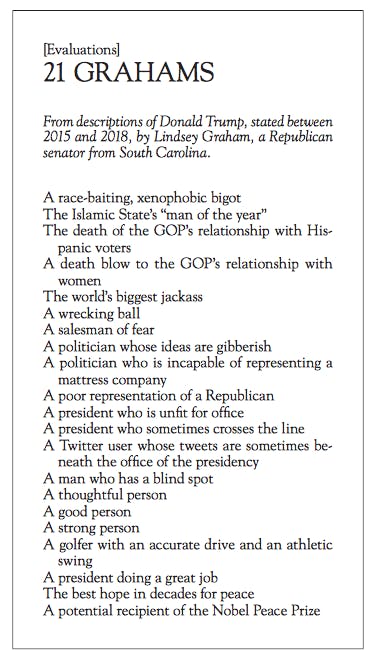
What happened to Lindsey Graham? Many journalists have spent the last two years trying to answer the question. New York magazine’s Lisa Miller cast him as a people-pleaser who’s long tried to build ties with both his party’s right flank and centrist Democrats. CNN placed him alongside other moderate GOP senators who’ve bowed to the president’s grip on the party base. The New York Times’ Mark Leibovich hinted that it was pure self-interest. Perhaps the most succinct analysis came from Harper’s, which simply listed 21 ways Graham had described Trump over the past three years. It begins with “a race-baiting, xenophobic bigot” and ends with “a potential recipient of the Nobel Peace Prize.”

The fascination with Graham’s transformation is justified. More than any other figure in conservative politics, he represents the Republican Party’s capitulation to Trumpism. He isn’t patient zero for this infection in the American body politic, of course. But the symptoms of fealty are so much more pronounced in Graham that they demand interrogation. By studying how the illness spread to him and reached its current stages, those trying to grapple with Trumpism hope to learn how it will run its course. Ultimately, though, the diagnosis may be less illuminating: Graham was never the principled Republican the press made him out to be.

Among those who have most shameless sold out to Trumpism, Graham’s closest competitors are former Texas Governor Rick Perry, who once denounced the president as a “cancer on conservatism” and now serves as his secretary of energy. Texas Senator Ted Cruz upended the 2016 GOP convention by pointedly refusing to endorse then-candidate Trump in a prime-time speech, then reversed course two months later after Trump added a few more names to his Supreme Court shortlist. In 2016, Mick Mulvaney, then a congressman and founding member of the Freedom Caucus, said, “Yes, I am supporting Donald Trump, but I’m doing so despite the fact that I think he’s a terrible human being.” He’s now the acting White House chief of staff.

But Graham stands apart. He’s more obsequious than most other top Republicans, often willing to appear on Fox News to defend Trump when others won’t. Even Mitch McConnell, one of Trump’s most reliable allies in the Senate, largely treats his relationship with the president as transactional. With Graham, however, the relationship appears to run deeper. The senator and the president regularly speak by phone and bond over their mutual love of golfing. After one such excursion in December 2017, Graham promoted Trump’s golf course on his personal Twitter account.

This wouldn’t be so remarkable if the president were, say, Jeb Bush. (In fact, Obama received his fair share of criticism for not building closer relationships with Democratic lawmakers on Capitol Hill.) But the buddy routine is a dizzying reversal from Graham’s past views. In the summer of 2015, he referred to Trump as the “world’s biggest jackass,” prompting Trump to retaliate by publicly revealing Graham’s personal cell phone number. “You know how to make America great again?” he quipped in a CNN interview that fall. “Tell Donald Trump to go to hell.” In a Twitter post from 2016 that goes viral anew whenever Graham publicly defends the president, he wrote, “If we nominate Trump, we will get destroyed.......and we will deserve it.” The list goes on.

So why the embrace? Political necessity partially explains it, as Graham nears re-election in 2020. Trump’s grip on the Republican primary electorate means candidates often need his support—or at least his silent assent—to win. There’s also some historical incentive for Graham to stay on his good side. As I noted earlier, the senator, who rose from the House to the upper chamber in 2003, was one of the few Republicans who regularly tangled with the insurgent Tea Party. But the timing of his re-election was fortunate: The anti-incumbency wave that swept through the GOP ranks in 2010 and 2012 had largely crested by 2014. The MAGA mood within the party, by comparison, is alive and well.

Access to power is the other part of the equation. Graham has mdae clear how much he craves the influence that his supine praise brings. “I have never been called this much by a president in my life,” he told the Times’ Leibovich in February. “It’s weird, and it’s flattering, and it creates some opportunity. It also creates some pressure.” Leibovich wrote that Graham spoke with “a mixture of amazement and amusement, with perhaps a dash of awe.”

It’s hardly novel for people to appeal to Trump’s vanity to get things out of him. That’s part of Graham’s strategy as well, especially on foreign policy matters. Though Trump is no peacenik, his skepticism toward prolonged U.S.-led interventions in Afghanistan and Iraq set him apart from the rest of the Republican field in 2016, especially compared to an uber-hawk like Graham. The flattery seems to have worked: Trump described Graham in February as someone “I respect, I listen to” on the Middle East. But Graham’s efforts to ingratiate himself go beyond mere policy issues, as he suggested to Leibovich.

“Well, O.K., from my point of view, if you know anything about me, it’d be odd not to do this,” he said.

I asked what “this” was. “ ‘This,’ ” Graham said, “is to try to be relevant.” Politics, he explained, was the art of what works and what brings desired outcomes. “I’ve got an opportunity up here working with the president to get some really good outcomes for the country,” he told me.


No matter how justified Graham thinks those causes may be, his defenses of Trump still lead to dark places. Graham, who once warned that firing special counsel Robert Mueller would be the ”beginning of the end” of Trump’s presidency, morphed into a fierce critic of the Russia investigation and the “deep state” supposedly behind it. When a reporter asked last week whether he thought the president’s attacks on Congresswoman Ilhan Omar were racist, Graham gave a novel explanation for why they weren’t. “A Somali refugee embracing Trump would not have been asked to go back,” he replied. “If you’re a racist, you want everybody from Somalia to go back cause they’re black or they’re Muslim.”

If Graham thought this was a defense of the president, he’s wrong. White supremacists have often set aside their hatred of non-white political figures for strategic reasons, as when Ku Klux Klan leaders met with Marcus Garvey or George Lincoln Rockwell addressed the Nation of Islam. Likewise, Trump is friendly toward individual people of color when they are his political allies and his public supporters (see: Kanye West). Graham’s interpretation of the president’s views here—that non-white Americans’ citizenship is contingent on their allegiance to the sitting president—is accurate. That he doesn’t seem to consider this morally abhorrent is the problem.

The most favorable interpretation of Graham’s actions is that he’s not spellbound by Trump in particular, but rather just willing to bow to whoever’s in charge in Washington. It’s the thread that connects his close ties to the George W. Bush administration, his across-the-aisle outreach to the Obama White House, and his awkward zeal to ingratiate himself with Trump. Plenty of politicians gravitate toward power and leap at any fleeting chance to exercise it; Graham just does it particularly well.

The tragedy of Graham’s reversal is that his initial assessment of Trump was correct. The president acts just as despicably as the South Carolina senator warned he would. Trump’s hostility toward the rule of law and his embrace of white nationalism are a defining challengefor this country. How Americans respond to this presidency is their ultimate moral test. Lindsey Graham may yet try to reinvent himself as a reasonable moderate partner for the next president. But for those who became sycophants to a racist golfer for personal gain, there can be no going back.

SHAREVISIT WEBSITE


Sunday, July 21, 2019

It’s Not Strategy, It’s Racism The New Republic / by Alex Shephard

It’s Not Strategy, It’s Racism


The New Republic / by Alex Shephard / 2d

The idea that Donald Trump plays “3D chess”has never been particularly plausible; still, it was one of the most persistent themes of the 2016 election. The concept was (and is), to be fair, quite appealing: Trump’s public persona may appear, on the outside, to be a completely improvised and rarely coherent mess, but, on the inside, everything is well oiled and well organized, brilliantly conceived to play outside the lines and win seemingly impossible victories.


The fact that Trump did end up winning the presidency made this theory even harder to kill. It was helped along by reporters and pundits, who used it to explain why they’d so badly misinterpreted the events leading up to the election. The chess meme was armor for prognosticators, proof that they got things wrong because Trump was a secret genius—not because they were, in fact, public fools. Since 2016, however, if the trope hasn’t exactly died, it’s yielded to an even simpler reality. In this White House, it has become impossible to ignore the fact that President Trump really doesn’t have any idea what he is doing. He is making it all up as he goes along. 

But, the 3D chess storyline rose from the dead this past week. On Sunday, the president sent out a series of vile, racist tweets aimed at four freshman Democrats in the House of Representatives—all women of color—known collectively as “The Squad.” These tweets may have been especially vivid, but they communicated what has been clear for years. As Jack O’Donnell, who worked with Trump in Atlantic City told The New York Times, “White people are Americans to Trump; everyone else is from somewhere else.” 

By Tuesday, many news outlets again began asking the same tediously familiar questions: Was the president just being an unhinged racist when he tweeted that four American citizens should “go back” to where they “came from?” Or was he executing a calculated piece of political strategy, the centerpiece of an orchestrated and savvy re-election campaign that will propel Trump to a second term in office? 

Democratic strategist David Axelrod tweetedthat the president “wants to raise the profile of his targets, drive Dems to defend them and make them emblematic of the entire party. It’s a cold, hard strategy.” CNN’s Jake Tapper surfaced an old quote from Steve Bannon, suggesting that Democrats always lose when they call out racism. The New York Times’s Frank Bruni, meanwhile, argued that Trump was trying to reframe the election, making it not against the eventual Democratic nominee, but against The Squad. “Against who they are individually. Against what they represent ideologically. Against what they telegraph about the demographic direction of the country and about a new distribution—a new sharing—of power,” Bruni wrote. Axios’s Mike Allen, meanwhile, reported that while “it might seem like improvisational madness when President Trump tells American citizens in Congress to ‘go back’ where they came from... those close to Trump say there’s a lot of calculation behind his race-baiting.” Trump, Allen reminded us, won older white voters by substantial margins, and he “watches Fox News and knows AOC, in particular, is catnip to old, white voters, especially men.” 

“She is young, Hispanic, female and a democratic socialist—a 4-for-4 grievance magnet,” penned Allen.

The argument here is that racism benefits Trump politically because it motivates his base, and because it forces Democrats to defend high-profile, left-of-center people of color, which further motivates his base. “Trump is proposing a giant swap: Republicans can no longer count on suburban women and we will continue to lose college-educated men and women, while we increasingly pick up working white Americans without college degrees,” former White House press secretary Ari Fleischer told The Washington Post. “Nobody knows who will come out ahead in the swap.”

It’s true that Trump’s support among Republicans has ticked up slightly in the wake of his tweets. But it’s also declined among independents. No one should ever take Fleischer at his word, but it’s worth noting that Trump basically rolled out this exact strategy during the 2018 midterms. In the final weeks of the campaign, Trump used rallies, Twitter, and his bully pulpit to fearmonger about undocumented immigrants and a migrant “caravan” approaching the southern border. As a result, Republicans lost across the country, and in historic fashion. Yes, there were a few victories in battleground districts, but overall, there were signs that this racist, divisive message wasn’t playing in states the president must win if he wants to be re-elected—states like Wisconsin, Michigan, and Pennsylvania. 

Go back even further, and there are more problems with this multidimensional “analysis.” While Trump won blue-collar white voters who rated immigration as a significant problem—and did so by large margins in 2016—the advantage came, in part, from wedding his nativist message to an economic one that included free trade and a full-throated defense of Medicare and Social Security. Now that he’s president, however, Trump’s trade policies have received (at best) mixed ratings from many of these same voters. And, given his administration’s approach to entitlements, the president will not be able to credibly make the same case for Medicare and Social Security. That hasn’t stopped him from making empty claims before, but it does suggest that Trump might need to offer more than just unadulterated racism to win in 2020. 

Looking at his short list of accomplishments, however, that’s basically all he has. He will undoubtedly run one of the most grotesque re-election campaigns of the post-civil rights era, but that is not to say that this week has been a preview of a deft, grand strategy. Instead, this was a confirmation of what’s been evident for the past several years, and what’s been known to Trump watchers for decades: The president is a bigot—maybe a lucky one, but a bigot all the same.

SHAREVISIT WEBSITE